11 main guides
Research foundations: from question to report
From research questions and gaps in the literature to design, sampling, data preparation and reporting.

17 reading series
Choose what you want to understand, then move from foundations to practice. Follow the next-guide links or open optional readings for specialised techniques and examples.
155 connected articles · Each article remains in the libraryChoose your reading goal11 main guides
From research questions and gaps in the literature to design, sampling, data preparation and reporting.
11 main guides · 4 further readings
Document decisions about questions, indicators, exploratory work and measurement confirmation.
5 main guides
Document prevention and evaluate the limits of common-method-bias evidence.
4 main guides · 1 further readings
Find the right version, organise your sources and check citation metadata before writing a review.
8 main guides · 2 further readings
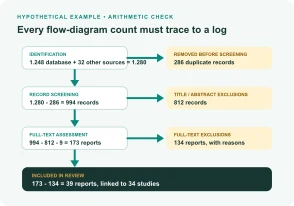
Write usable eligibility criteria, record your searches and screening decisions, and use those records to reconcile the flow diagram and report the review.
5 main guides · 6 further readings
Choose analyses for the question and variable types, interpret regression results and document the checks.
6 main guides · 6 further readings
Set thinking, calibration, truth tables, solutions, robustness and combined analyses.
7 main guides · 3 further readings
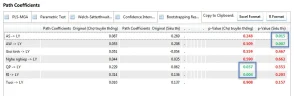
Explain the model, data and comparison choices before interpreting coefficients.
6 main guides · 5 further readings
Distinguish data, specification and reporting issues before modifying a model.
4 main guides
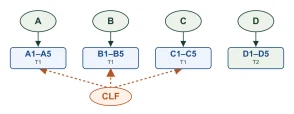
Distinguish the models, compute item-level method shares and report what the sensitivity analysis supports.
6 main guides · 5 further readings
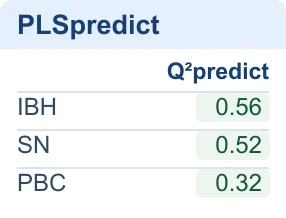
Distinguish explanatory fit from out-of-sample prediction and interpret predictive outputs together.
9 main guides
Choose the estimand and interpret it alongside confidence intervals rather than p-values alone.
6 main guides · 4 further readings
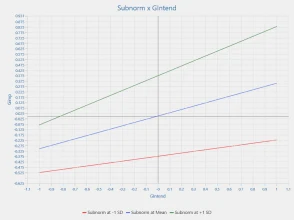
Choose a moderator value, define the estimand, and read the confidence interval for the effect or contrast you plan to report.
4 main guides · 3 further readings
Choose a workflow for known groups or unobserved segments and interpret MICOM, MGA and segmentation results.
6 main guides · 6 further readings
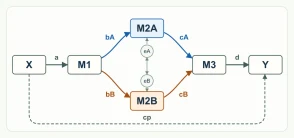
Identify a relevant extension and the limits of its conclusions.
10 main guides · 2 further readings
Distinguish reported results, recalculations and illustrations; document markers, CLF, VIF and sensitivity of substantive relationships.
5 main guides · 3 further readings
Prepare a manuscript and submission record with explicit checks.
Thumbnail from Drake & Han (2025) · CC BY 4.0
 SPSS
 AMOS · CFA
 SmartPLS 4