
Confirmatory Tetrad Analysis in PLS-SEM: Using It for Its Intended Role
CTA-PLS examines tetrad constraints implied by reflective models, but measurement-model decisions must still begin with the causal relationship between concepts and indicators.
Tetrads significantly different from 0 may warn of reflective misspecification. Do not use CTA-PLS alone to reverse measurement direction; combine theory, indicator content, interchangeability, and the consequences of indicator removal.
CTA: testing measurement-model restrictions
- Concept
Clarify the construct definition
- Specification
Specify measurement directions
- Tetrad
Test the implied restrictions
- Synthesis
Interpret alongside theory
Conceptual diagram. CTA supplements theory; it does not determine reflective or formative status alone.
Source: Lê Minh · Conceptual illustration, not software output.1. What Is a Tetrad?
A tetrad is the difference between two products of covariances. Under a correctly specified reflective common-factor model, certain population tetrads are expected to equal 0 (Gudergan et al., 2008).
CTA-PLS uses bootstrapping to assess tetrad confidence intervals. If multiple relevant tetrads have intervals excluding 0, the reflective model may be misspecified.
2. Theory Comes Before Statistics
| Question | Reflective | Formative/composite |
|---|---|---|
| Causal direction | The concept causes indicators | Indicators form the concept |
| Are indicators interchangeable? | Usually share some similarity | Not necessarily |
| Removing an indicator | Little change to the conceptual domain if sufficient content remains | May alter the concept’s meaning |
| Covariation | Expected | Not a core requirement |
A CTA-PLS result cannot transform a concept’s consequences into formative components, or vice versa.
3. A Workflow for Using CTA-PLS
Specify the model theoretically
Document causal direction, content domain, and each indicator’s role.
Estimate the initial model
Check data, coding, and the measurement model before CTA.
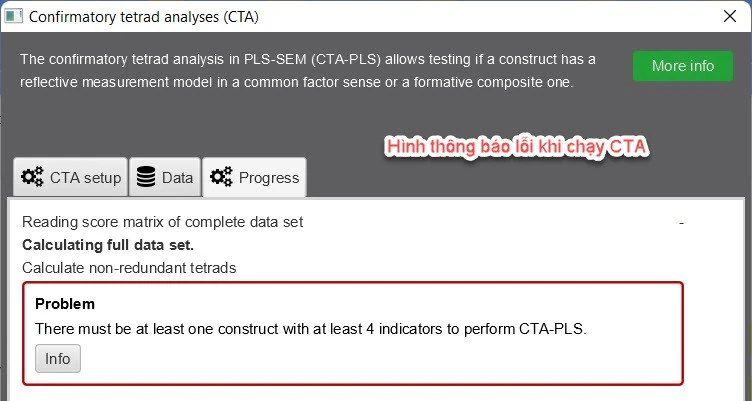
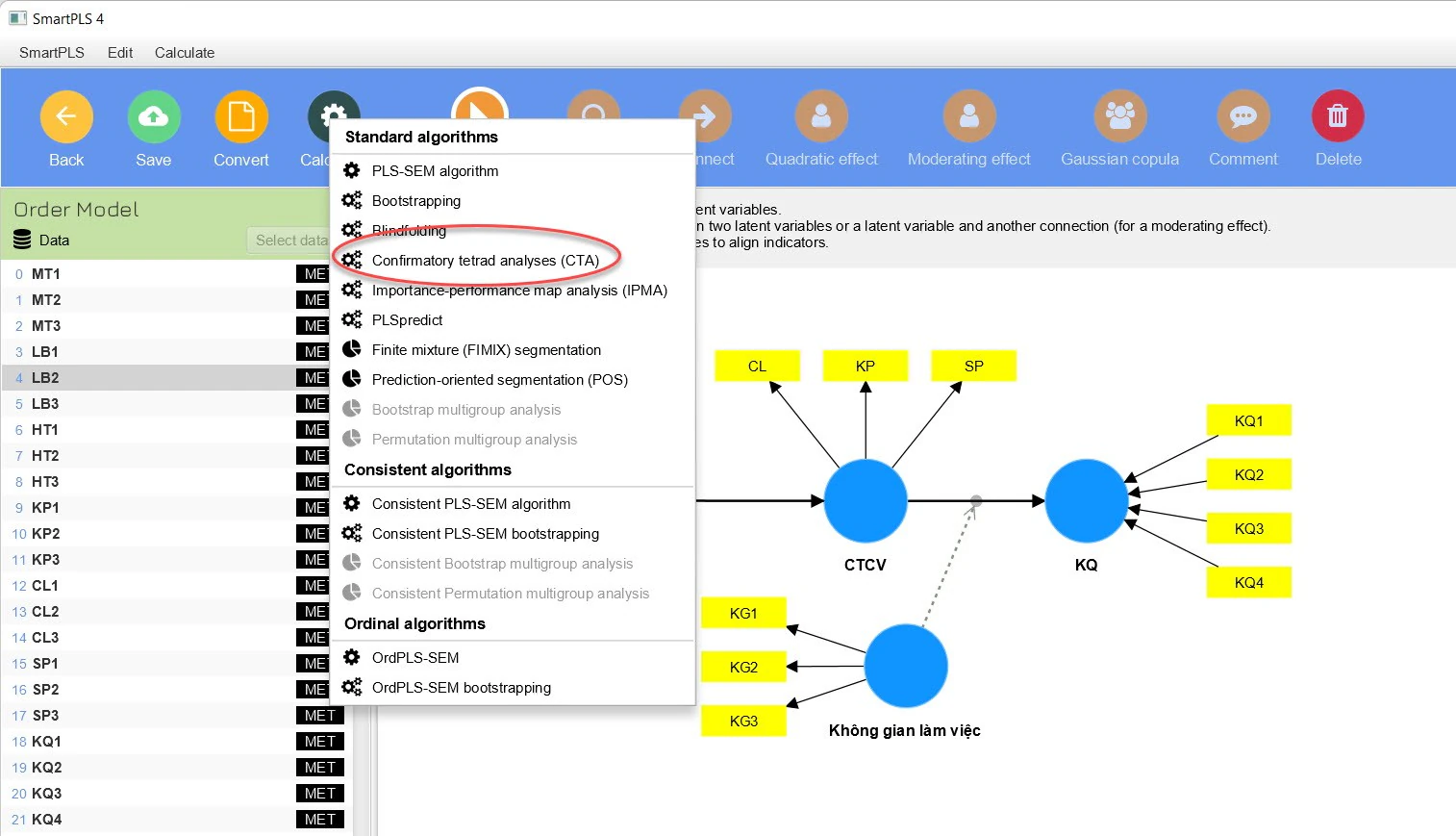
Run CTA-PLS
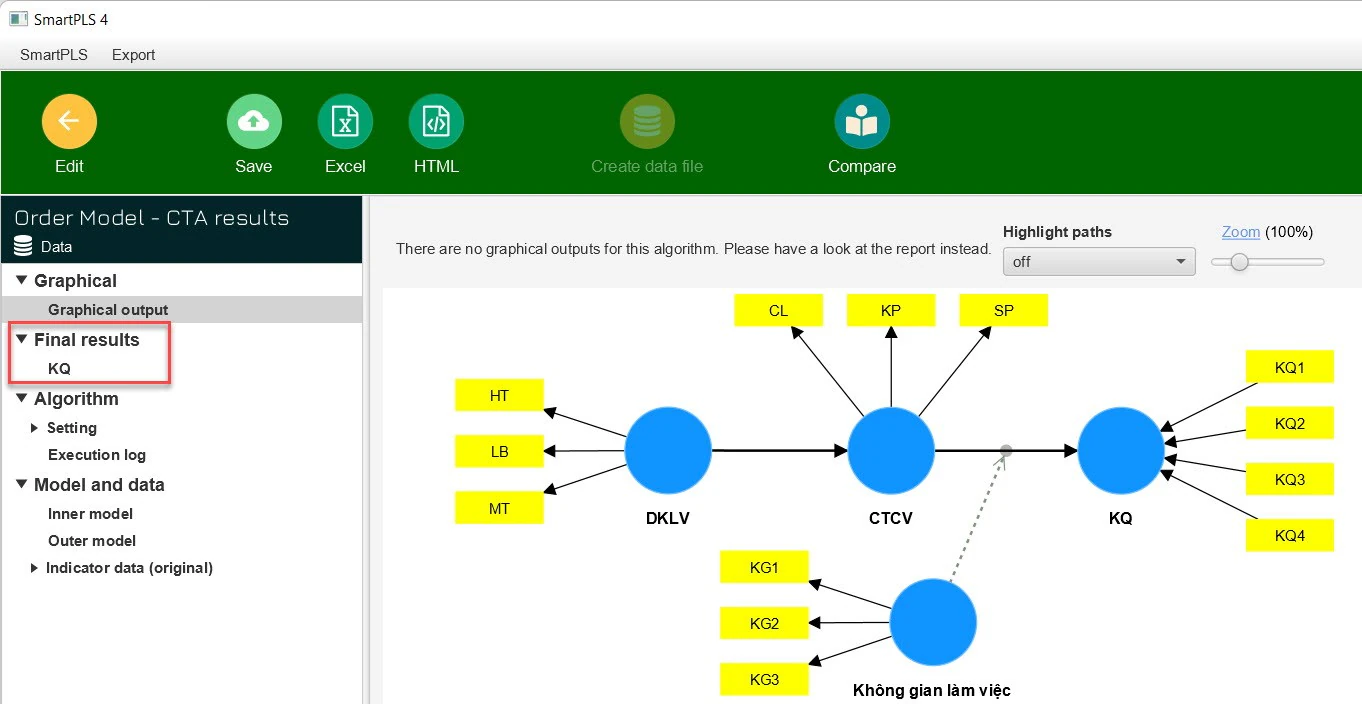
Use bootstrapping and examine confidence intervals for all relevant tetrads.
Look for patterns
Do not conclude from one isolated tetrad; consider their number, signs, and consistency.
Assess alternative models
Compare justified specifications and transparently report decisions.
4. Reporting Template
Example report
Based on theory, [construct] was specified as [reflective/composite]. CTA-PLS with [number] bootstrap samples indicated that [number] tetrads had confidence intervals [not] containing 0. The results were treated as [consistent with/a warning about] the initial specification; the final decision also considered causal direction and indicator content.
- Theory precedes CTA.
- Report bootstrap count and CIs.
- Interpret patterns rather than selecting one p-value.
- Do not change specification merely to improve indices.
- Identify the alternative models considered.
- Preserve the full content domain.
Conclusion
CTA-PLS is a specification diagnostic rather than the sole arbiter. Trustworthy conclusions arise from agreement among measurement theory, indicator structure, and tetrad evidence.
References
- Gudergan, S. P., Ringle, C. M., Wende, S., & Will, A. (2008). Confirmatory tetrad analysis in PLS path modeling. Journal of Business Research, 61(12), 1238–1249.https://doi.org/10.1016/j.jbusres.2008.01.012
Academic note: CTA-PLS is most appropriate as a supplementary assessment of a theoretically grounded reflective specification.