fsQCA: from configurational thinking to applications
Connected guides to set thinking, calibration, truth tables, solutions and robustness. Work through the OSP example before exploring combinations with SEM, NCA, ANN and longitudinal designs.
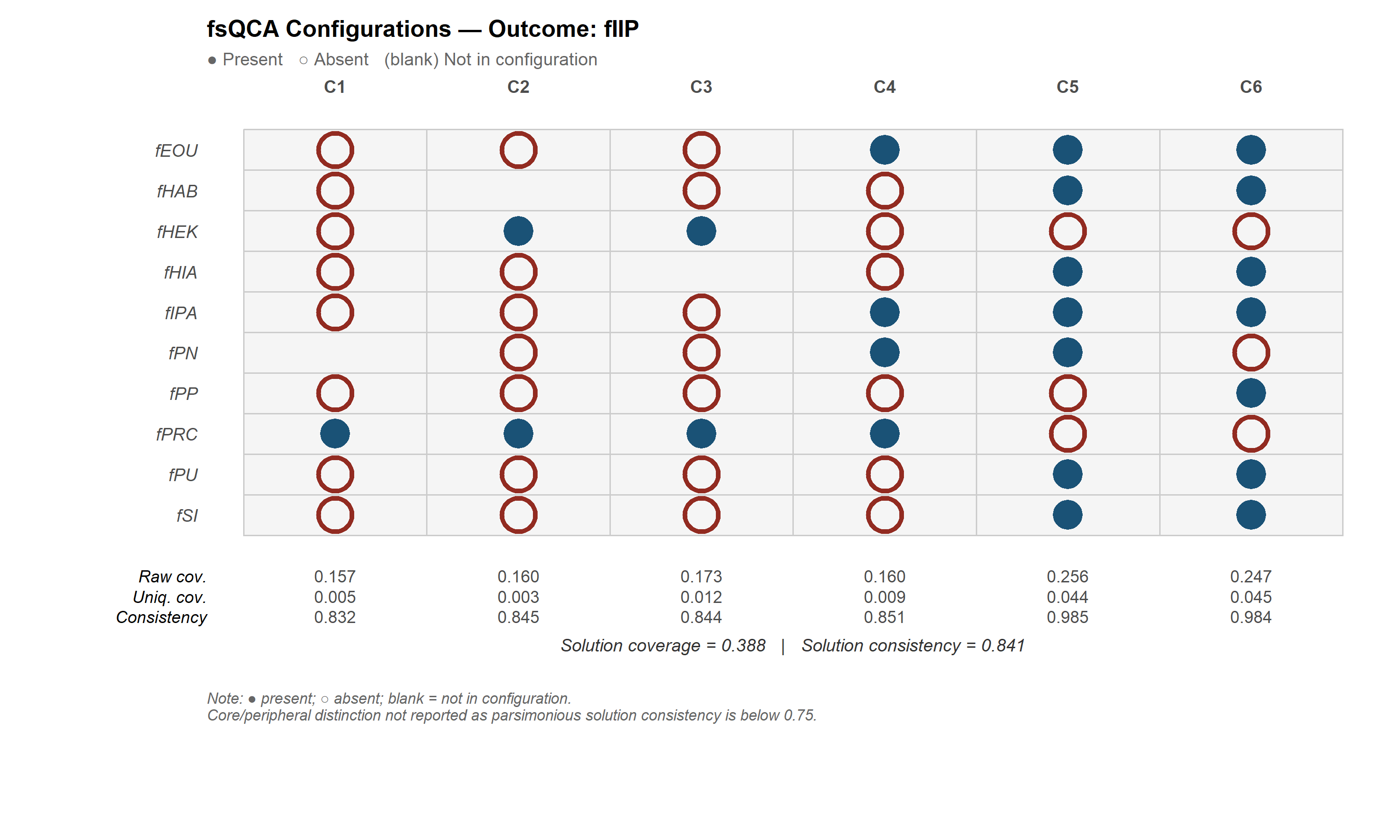
Original English-language chart supplied by Lê Minh. This is a separate illustration, not the OSP example. Numerical teaching examples are distinguished from published research findings.
Choose the stage you need.
Read in order from 01 to 06, or open the worked example if you already know the foundations.
fsQCA: from configurational thinking to applications
Regression and SEM often estimate the conditional contribution of individual predictors. Many management questions instead concern combinations: which strategy works with which structure, and whether another combination can reach the same outcome. Configurational thinking helps formulate that question before choosing fsQCA.
fsQCA: from configurational thinking to applications
Much of the credibility of an fsQCA analysis is determined before minimization: by its calibration anchors, handling of exact 0.5 scores, and frequency and consistency thresholds. This guide explains those decisions and how to report them.
fsQCA: from configurational thinking to applications
Complex, parsimonious and intermediate solutions differ in the assumptions they permit about combinations not sufficiently observed in the data. Understanding that distinction helps explain a solution, classify core and peripheral elements and answer questions about counterfactual reasoning.
fsQCA: from configurational thinking to applications
An fsQCA solution depends on calibration, frequency, consistency and simplifying assumptions. Robustness assessment asks whether its substantive interpretation survives other choices that are also defensible, rather than whether every possible setting produces identical output.
fsQCA: from configurational thinking to applications
Follow an fsQCA workflow for OSP with four conditions, using the fsQCA 4.1 interface described in the source walkthrough. The numerical tables illustrate interpretation; they are not outputs reproducible from the four example rows in Table 2. The guide connects calibration, exact 0.5 values, truth tables, solutions and robustness.
fsQCA: from configurational thinking to applications
Choose how to combine fsQCA with CB-SEM, PLS-SEM, NCA, ANN, Delphi and longitudinal data. Distinguish modeled relationships, necessity, sufficient configurations and prediction through ten critically assessed applications.