
Obtaining standardized results from user-defined estimands in AMOS
AMOS reports standardized coefficients for the paths in a model. Reporting a custom quantity, such as the indirect effect through one named mediator, requires an expression that specifies the coefficients and their units. This guide uses one model to show how to obtain and cross-check both types of output.
Start readingIdentify the quantity before opening the output
An estimand is the quantity you intend to estimate. You can read a path coefficient or the overall indirect effect between two variables from the built-in output. To isolate one pathway or evaluate an effect at a chosen moderator value, name and define the quantity in User-defined estimands.
Open View → Analysis Properties → Output. Select Standardized estimates for standardized regression weights. Also select Indirect, direct & total effects to display the corresponding effect tables. These switches control the output display and leave your expression as written. For example, p.a1 * p.b1 still multiplies coefficients in the original units. (Amos Development Corporation, n.d.-e, n.d.-c)
Retrieve a direct effect and the overall indirect effect
Consider a teaching model with observed variables. X is practice time, M1 is task accuracy, M2 is confidence and Y is a practical assessment score. X reaches Y through two parallel routes, X → M1 → Y and X → M2 → Y, and through a direct path X → Y. Neither mediator is modeled as a predictor of the other.
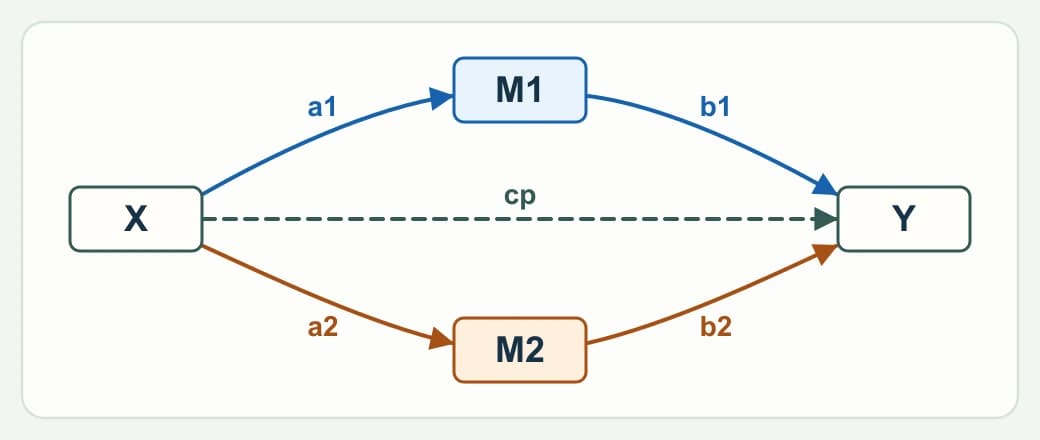
Both built-in functions take the target variable first and the source variable second. Direct_XY_std retrieves the direct X-to-Y coefficient. Indirect_XY_std combines the indirect X-to-Y pathways in the model. The total effect is the direct effect plus the overall indirect effect. (Amos Development Corporation, n.d.-d, n.d.-f, n.d.-a)
Direct_XY_std = e.StandardizedDirectEffect(Y, X)
Indirect_XY_std = e.StandardizedIndirectEffect(Y, X)
Cross-check the two estimates against row Y, column X in Standardized Direct Effects and Standardized Indirect Effects for the same group and fitted model. If the values differ, check the argument order and model specification before interpreting either estimate.
Define each specific indirect pathway
Label X → M1 and M1 → Y as a1 and b1. Use a2 and b2 for the M2 route. AMOS uses the prefix p. to retrieve a named parameter. Multiply the coefficients on the required pathway and rescale the product by SD(X)/SD(Y). With a consistent standardization convention, the intervening variable's standard deviation cancels in the product. (Amos Development Corporation, n.d.-g)
Via_M1_std = p.a1 * p.b1 * Math.Sqrt(e.ImpliedCovariance(X, X) / e.ImpliedCovariance(Y, Y))
Via_M2_std = p.a2 * p.b2 * Math.Sqrt(e.ImpliedCovariance(X, X) / e.ImpliedCovariance(Y, Y))
e.ImpliedCovariance(X, X) returns the model-implied marginal variance of X. Pass the same variable twice to retrieve a diagonal entry, then use Math.Sqrt on the variance ratio to obtain the standard deviation ratio. For the endpoint Y, use its marginal variance. Its residual variance is a different quantity. (Amos Development Corporation, n.d.-b, n.d.-c)
Suppose a1 = 0.40, b1 = 0.50, a2 = 0.30, b2 = 0.20 and the direct path is 0.10. Use SD(X) = 2 and SD(Y) = 5. The table gives the hand calculation. Every value is hypothetical.
| Quantity | Original units | Standardized units |
|---|---|---|
| Direct X → Y | 0.100 | 0.040 |
| Indirect via M1 | 0.400 × 0.500 = 0.200 | 0.080 |
| Indirect via M2 | 0.300 × 0.200 = 0.060 | 0.024 |
| Overall indirect effect | 0.260 | 0.104 |
An increase of one standard deviation in X corresponds to a model-implied change of 0.080 standard deviations in Y through M1. The two routes sum to 0.104. This cross-check covers the two paths in this diagram. If your model contains more or longer pathways, enumerate all of them before checking the sum.
Keep the moderator value on its fitted scale
Extend the example by letting W moderate X → M1. Include W and the X × W product in the M1 equation and label the product coefficient int1. At W = w, the original-unit slope is a1 + int1 × w. When the M1 → Y coefficient b1 stays constant across W, multiply the slope by b1 for the indirect effect through M1 at the same value of w (Friedrich, 1982).
At W = 1 in the model's units, rescale the slope by SD(X)/SD(M1) and the indirect effect by SD(X)/SD(Y). If the fitted W has been mean centered, 1 denotes one unit on that centered scale. Interpret it as one standard deviation only when W was defined in those units.
Slope_M1_w1_std = (p.a1 + p.int1 * 1) * Math.Sqrt(e.ImpliedCovariance(X, X) / e.ImpliedCovariance(M1, M1))
Via_M1_w1_std = (p.a1 + p.int1 * 1) * p.b1 * Math.Sqrt(e.ImpliedCovariance(X, X) / e.ImpliedCovariance(Y, Y))
Continue the hypothetical example with int1 = 0.15 and SD(M1) = 4. The slope at W = 1 is 0.55 in original units and 0.275 after standardizing. The standardized indirect effect via M1 is 0.55 × 0.50 × 2/5 = 0.110. The Standardizing simple slopes and conditional indirect effects in AMOS examines the same decisions about moderator values and variances in a different worked model.
Check the expressions and read their bootstrap results
- Inspect the fitted model. Verify the variable names and parameter labels in the diagram. Give distinct labels to parameters you intend to estimate separately. Check the solution, variances and path estimates before reading a derived result.
- Enter the expressions. Select Define new estimands from the status bar, enter one expression per line and run Check Syntax. Start with the direct-effect check against the standard output, then add the quantities for your report. (Amos Development Corporation, n.d.-c, n.d.-g)
- Request the bootstrap. Under Analysis Properties → Bootstrap, select Perform bootstrap and set the resample count, interval method and confidence level in line with the analysis plan. Ordinary case resampling assumes independent sampling units. Clustered data call for a method that respects the sampling structure. (Amos Development Corporation, n.d.-g)
- Match the output rows. Open Text Output → Estimates → Scalars → User-defined estimands for Estimate. Match that name in Bootstrap standard errors and the interval table for the SE and both limits. If you used the Bias-corrected percentile method, report that name. The BCa designation requires an additional acceleration adjustment (Efron, 1987). (Amos Development Corporation, n.d.-g)
Including the standard deviation ratio in the expression lets AMOS re-estimate it alongside the coefficients in each bootstrap sample. Entering a precomputed ratio holds it fixed across resamples. Likewise, 1 in the conditional example keeps the moderator value fixed. Defining W through a mean or standard deviation recalculated in each resample would target a different quantity.
Reporting template. For the indirect effect via M1 at W = [value and scale], report the estimate standardized using the model-implied marginal SDs of X and Y, its bootstrap SE, the interval method and confidence level, both limits and the number of usable resamples. Take these numbers from the named estimand in the fitted model.
To compare two pathways, define their contrast in the same model and obtain the SE and CI for the contrast itself. The guide to comparing two serial mediation chains in AMOS uses this approach for the Difference row.
References
- Amos Development Corporation. (n.d.-a). Definition of direct, indirect and total effects. AMOS documentation.
- Amos Development Corporation. (n.d.-b). ImpliedCovariance method. AMOS documentation.
- Amos Development Corporation. (n.d.-c). Simple user-defined estimands. AMOS documentation.
- Amos Development Corporation. (n.d.-d). StandardizedDirectEffect method. AMOS documentation.
- Amos Development Corporation. (n.d.-e). Standardized estimates. AMOS documentation.
- Amos Development Corporation. (n.d.-f). StandardizedIndirectEffect method. AMOS documentation.
- Amos Development Corporation. (n.d.-g). User-defined estimands [Tutorial]. AMOS documentation.
- Efron, B. (1987). Better bootstrap confidence intervals. Journal of the American Statistical Association, 82(397), 171–185. DOI.
- Friedrich, R. J. (1982). In defense of multiplicative terms in multiple regression equations. American Journal of Political Science, 26(4), 797–833. DOI.