
Bootstrapping Indirect Effects in AMOS: From Estimand to Reporting
Direct evidence for mediation comes from the confidence interval of a x b. Significant component paths, or a direct effect becoming nonsignificant, do not replace testing the indirect effect.
Begin with a prespecified estimand, valid measurement and justified causal ordering. Then bootstrap, inspect successful resamples, interpret each unstandardized specific indirect effect, compare the direct effect and report causal limitations.
Mediation: distinguish direct and indirect effects
- Variable X
Predictor
- Mediator M
The hypothesised intervening pathway
- Outcome Y
Outcome
Conceptual diagram. Assess the indirect effect with uncertainty; VAF is descriptive.
Source: Lê Minh · Conceptual illustration, not software output.1. Learning objectives and prerequisites
You should be able to identify direct, indirect and total effects, label AMOS parameters, define specific indirect effects for multiple mediators, bootstrap, interpret confidence intervals and write an assessable results paragraph.
Prerequisites are an evaluated measurement model, identified structural model and theoretically or temporally justified X, M, Y order. AMOS estimates statistical relationships; it cannot create causal ordering from cross-sectional data.
- Define and measure X, M and Y clearly.
- Justify X to M to Y theoretically or temporally.
- Obtain an admissible measurement solution.
- Prespecify covariates before inspecting results.
- List the specific indirect effects to report.
- Consider sample size and missing-data strategy.
2. Define the estimand before bootstrapping
In simple mediation, a links X to M, b links M to Y controlling for X, c-prime is the direct X to Y effect, and a x b is indirect. The total effect is c-prime + a x b. Name these distinct quantities clearly.
The main estimand should be the unstandardized indirect effect, calculated directly from original-scale coefficients. A standardized effect can supplement magnitude interpretation, but standardization must be consistent and its CI must target that standardized quantity (Cheung, 2009).
With several mediators, total indirect effect sums indirect paths without identifying which mediator provides the mechanism. Questions about individual mechanisms require separate specific indirect effects.
| Quantity | Expression | Question |
|---|---|---|
| Path a | X to M | How is X related to the mediator? |
| Path b | M to Y, controlling for X | How is M related to Y conditional on X? |
| Direct effect | c-prime | X to Y association not transmitted through M in this model? |
| Specific indirect | a x b | How strong is this mediator’s mechanism? |
| Total indirect | Sum of specific indirect effects | All indirect paths in the model? |
| Total effect | c-prime + sum of indirect effects | Total association decomposed by the model? |
3. Why bootstrap the product a x b?
An indirect effect is a product of coefficients. Its sampling distribution is often asymmetric, especially when either component is near 0. Normal-approximation intervals can be unbalanced in this setting (MacKinnon, Lockwood, & Williams, 2004).
Bootstrap resamples observations with replacement, refits the model and obtains an empirical indirect-effect distribution. Preacher and Hayes (2008) recommend direct bootstrap-CI inference rather than requiring separate paths to cross a p-value threshold.
Bootstrap still depends on sample quality and specification. It cannot repair confounding, unmodeled measurement error, unclear temporal ordering or nonconvergent resamples.
For a two-sided 95% CI, an indirect effect is supported when the entire interval lies on one side of 0. Do not decide from bootstrap standard error alone.
4. Prepare the AMOS model and label parameters
Draw X, M and Y according to theory and retain X to Y when decomposing total effect. Complete latent-variable measurement before adding structural paths. Every endogenous variable needs a disturbance.
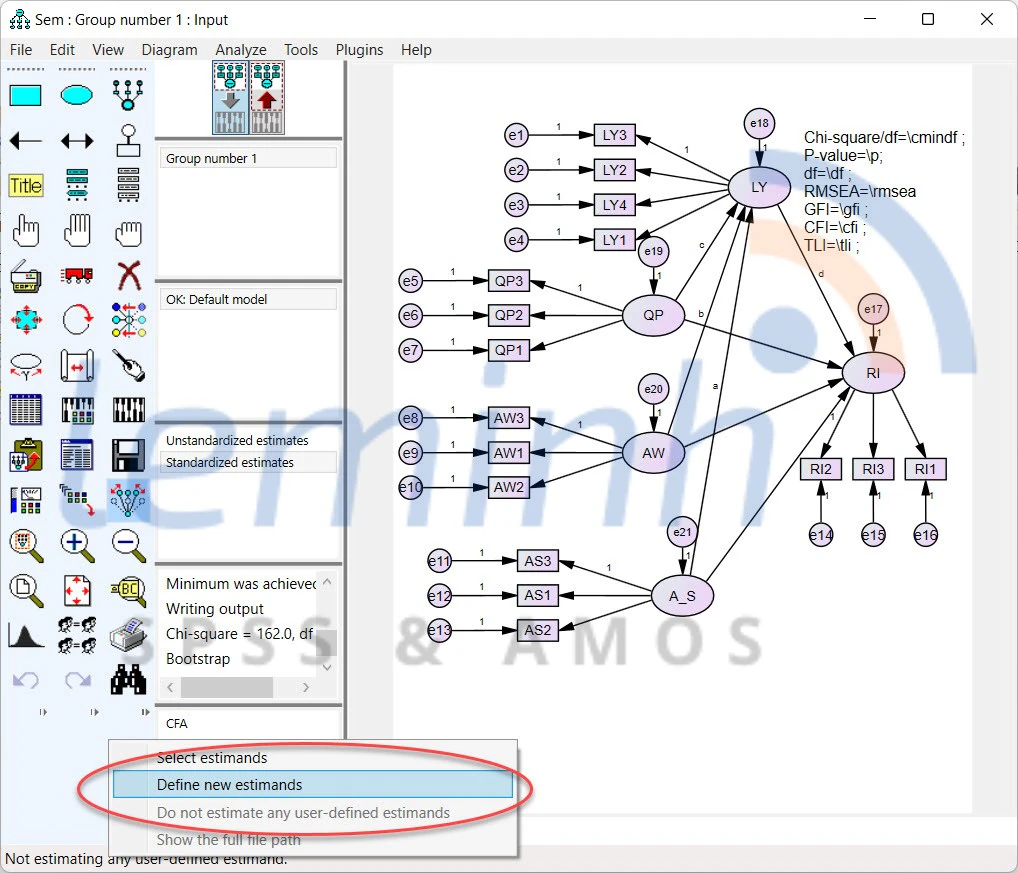
In Object Properties, label relevant regression weights, such as a, b and cp. For multiple mediators, structured names such as a1, b1, a2 and b2 reduce confusion. IBM Corp. (2022) describes direct, indirect and total effects and user-defined estimands for quantities not supplied by default.
User-defined estimands are especially important for parallel or serial mediation. A default total indirect effect cannot replace a1 x b1, a2 x b2 or a1 x d21 x b2.
Complete measurement
Assess loadings, reliability, validity, fit and improper solutions before structural paths.
Draw the complete structural model
Retain direct paths and prespecified covariates for consistent decomposition.
Label regression weights
Use a, b, cp or mediator-specific names without duplicate labels.
Define indirect estimands
List each required parameter product and total indirect effect where relevant.
Check scaling
Use unstandardized coefficients for the main estimand; standardized effects are supplementary.
Save a prebootstrap version
Preserve model, data and parameter-label records to reproduce calculations.
5. Configure bootstrap and confidence intervals
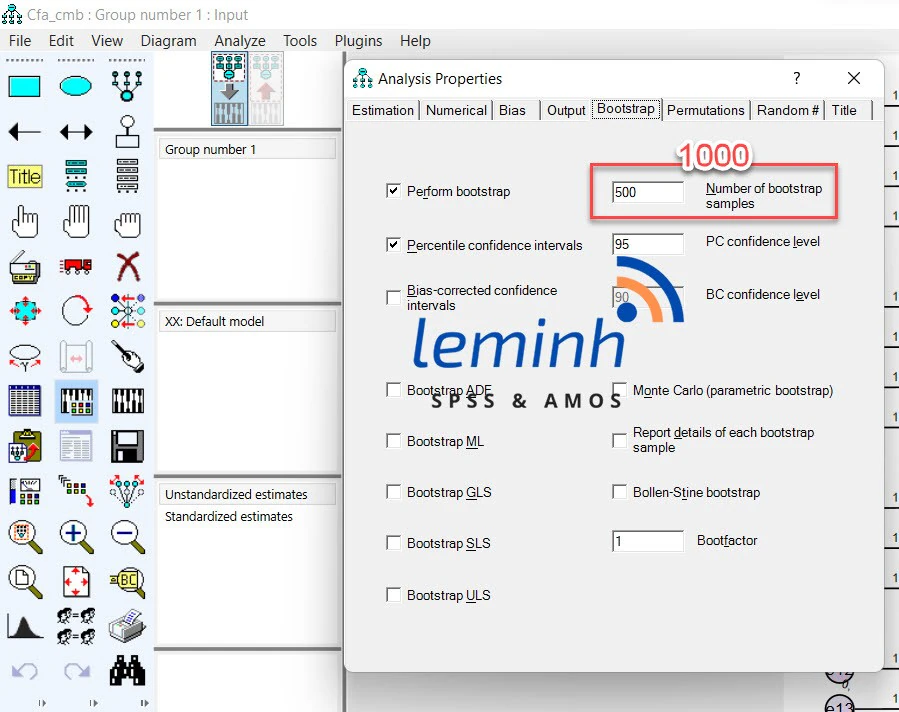
Enable bootstrap in Analysis Properties and choose resamples. Five thousand is often a reasonable practical choice but does not guarantee accuracy for every model. Use enough resamples to stabilize CI quantiles.
Percentile and bias-corrected intervals differ. Cheung (2009) shows differing coverage for standardized indirect effects. Select and report the interval type before seeing results rather than trying several and keeping the favorable one.
Inspect successful bootstrap estimates. Substantial nonconvergence can indicate identification, starting-value, outlier, sample-size or complexity problems. Do not report a CI as though every requested resample were valid.
Open Analysis Properties
Select Bootstrap and set the resample count.
Choose the confidence level
Use the prespecified level, often 95% for main reporting.
Choose the interval type
Record percentile or bias-corrected according to the plan and AMOS version.
Request indirect, direct and total effects
Obtain the output needed to check decomposition.
Run the model
Monitor warnings, inadmissible solutions and bootstrap failures.
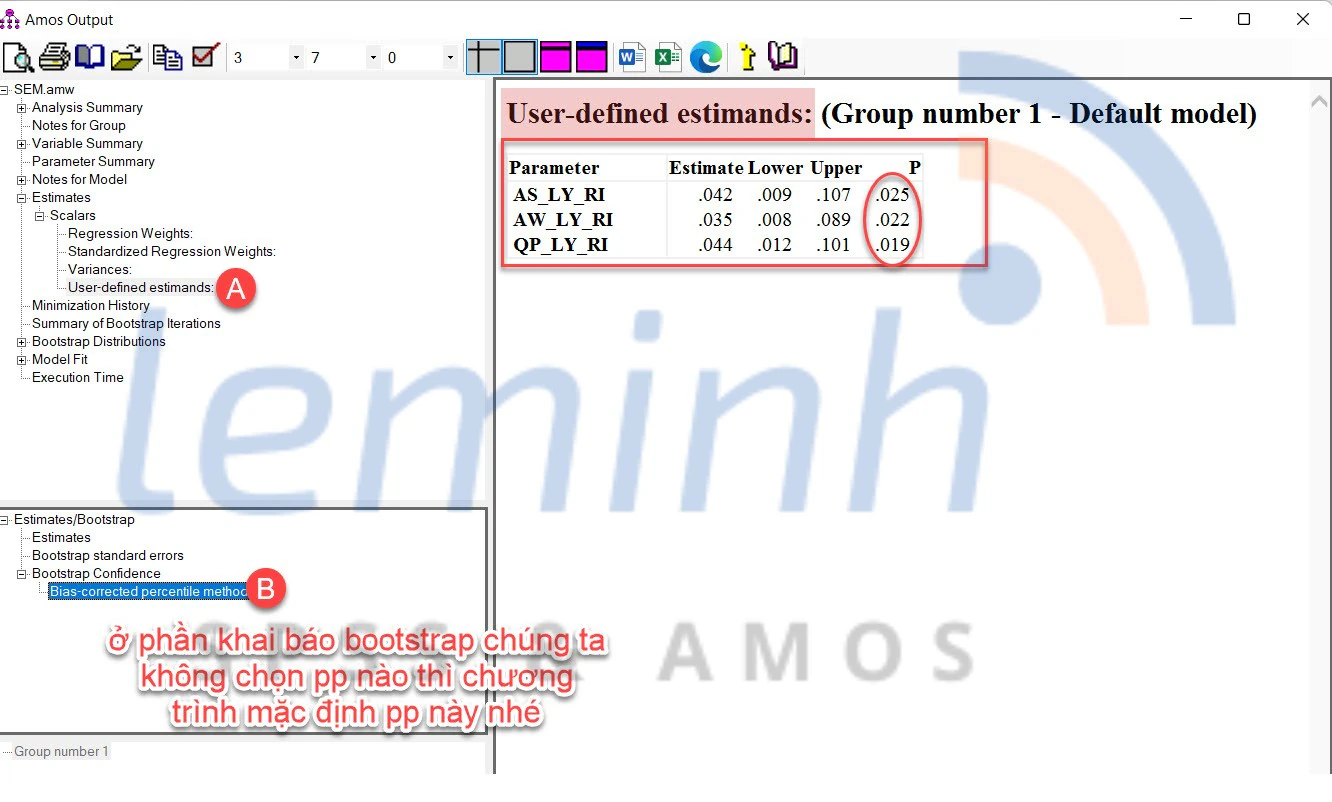
Read user-defined estimands
Obtain estimates and lower/upper bounds for every specific indirect effect.
Preserve original output
Save all output and settings, not only significant tables.
6. Parallel and serial mediation: avoid confusing total indirect effects
In parallel mediation, X predicts several mediators, each linked to Y. Specific effects are a1 x b1 through M1 and a2 x b2 through M2; total indirect effect is their sum. Opposite signs can produce a total near 0 despite clear individual mechanisms.
In serial mediation, X to M1 to M2 to Y corresponds to a1 x d21 x b2. Shorter paths may also be present. Each product must match the hypothesis.
Preacher and Hayes (2008) discuss estimating and comparing indirect effects in multiple-mediator models. Claiming M1 is stronger than M2 requires a CI for their difference, not separate p-value comparisons.
| Configuration | Estimand | Avoid |
|---|---|---|
| One mediator | a x b | Inspecting only a and b |
| Two parallel mediators | a1 x b1; a2 x b2 | Reporting only total indirect effect |
| M1 to M2 chain | a1 x d21 x b2 | Omitting a component from the product |
| Compare two mechanisms | a1b1 - a2b2 | Comparing their p-values |
| Moderated mediation | Conditional indirect effect | One fixed a x b for every moderator level |
7. Hypothetical calculation and interpretation
This is an illustrative example, not empirical data. Let X be information quality, M trust and Y continuance intention. AMOS yields a = 0.42, b = 0.36 and c-prime = 0.18.
The unstandardized indirect effect is 0.42 x 0.36 = 0.151. With 5,000 bootstrap samples, its percentile 95% CI is [0.071; 0.246]. Excluding 0 supports a positive indirect effect in the specified model.
The total effect is 0.18 + 0.151 = 0.331. The direct effect remains positive with CI [0.035; 0.325], excluding 0. Rather than automatically labeling partial mediation, describe supported direct and indirect effects and interpret them theoretically.
| Effect | Estimate | 95% bootstrap CI | Interpretation |
|---|---|---|---|
| a: X to M | 0,420 | [0,290; 0,551] | Positive association |
| b: M to Y | 0,360 | [0,221; 0,505] | Positive association conditional on X |
| Indirect a x b | 0,151 | [0,071; 0,246] | CI excludes 0 |
| Direct c-prime | 0,180 | [0,035; 0,325] | Direct effect remains supported |
| Total effect | 0,331 | [0,184; 0,475] | Total modeled association |
Do not use these coefficients or intervals as thresholds for other studies. Substantive meaning depends on scale, context and design.
8. Interpret mediation without reverting to older decision rules
A significant total effect is not required before testing indirect effects. Zhao, Lynch and Chen (2010) and Rucker et al. (2011) explain that requiring significance may miss indirect mechanisms, especially opposing paths.
A nonsignificant direct effect does not establish full mediation. It describes c-prime uncertainty in this model and sample. Full/partial labels often obscure estimates, CIs and potentially omitted mediators.
State the indirect effect through M, its CI, the remaining direct effect and the design limiting the conclusion.
Prioritize indirect-effect magnitude and CI. Avoid reducing mediation to a decision tree based only on c or c-prime significance.
9. Causal mediation needs more than an AMOS model
A statistical indirect effect is not automatically a causal mechanism. Causal interpretation requires temporal order, confounding control for X-M, M-Y and X-Y, and appropriate handling of post-treatment confounders.
Simultaneous cross-sectional measurement does not observe a process unfolding over time. Bootstrap quantifies sampling uncertainty under the model; it does not test causal assumptions.
For clustered, longitudinal or repeated-measures data, resampling must match the independent unit. Resampling individual rows within clusters can understate uncertainty.
10. Common operational and interpretive mistakes
| Weak practice | Problem | Response |
|---|---|---|
| a and b both p < .05, therefore mediation | No direct product test | Report the bootstrap CI for a x b |
| Stop when total effect is nonsignificant | Can miss opposing indirect effects | Test the hypothesized estimand |
| Nonsignificant c-prime means full mediation | Does not establish a complete mechanism | Report estimates/CIs; avoid automatic labels |
| Report only total indirect effect | Conceals specific mechanisms | Define every specific indirect effect |
| Choose a favorable CI after estimation | Increases researcher degrees of freedom | Prespecify CI type |
| Ignore failed resamples | The CI may use fewer solutions than intended | Report successful resamples |
| Arbitrarily multiply standardized a and b | Standardization may be inconsistent | Use the estimand generated directly by AMOS |
11. APA 7 reporting template and checklist
The template uses hypothetical values. Replace them with actual output and state the AMOS version, CI type, requested resamples and successful resamples.
Reporting example in English
Mediation was estimated using IBM SPSS Amos [version]. The specific indirect effect of X on Y through M was ab = .151, percentile bootstrap 95% CI [.071, .246], using 5,000 resamples ([number] converged). The CI excluded 0, supporting a positive indirect effect. The remaining direct effect was c-prime = .180, 95% CI [.035, .325], and the total effect was .331, 95% CI [.184, .475]. Findings were interpreted as indirect associations in [cross-sectional/longitudinal/experimental] data, without causal claims beyond the design.
- Prespecify the indirect estimand.
- Retain the direct path when decomposing total effect.
- Label regression weights correctly.
- Define specific effects for multiple mediators.
- Use unstandardized coefficients for the main estimand.
- Report resamples and confidence level.
- Identify percentile or bias-corrected intervals.
- Check successful bootstrap samples.
- Read indirect-effect CIs rather than a and b alone.
- Do not require a significant total effect.
- Do not use full/partial labels as the sole conclusion.
- Report direct, indirect and total effects where relevant.
- State causal limits and data structure.
- Match citations with references.
Conclusion
Trustworthy bootstrap mediation requires a prespecified estimand, valid measurement and direct CI interpretation for every indirect effect. More resamples cannot compensate for misspecification or an unjustified mechanism.
Report estimates, CIs, direct and total effects, successful samples and design limitations. Readers need the strength of evidence, not merely a mediation label.
References
- Cheung, M. W. L. (2009). Comparison of methods for constructing confidence intervals of standardized indirect effects. Behavior Research Methods, 41(2), 425-438.https://doi.org/10.3758/BRM.41.2.425
- IBM Corp. (2022). IBM SPSS Amos 29 user's guide.https://www.ibm.com/docs/en/SSLVMB_29.0.0/pdf/IBM_SPSS_Amos_User_Guide.pdf
- MacKinnon, D. P., Lockwood, C. M., & Williams, J. (2004). Confidence limits for the indirect effect: Distribution of the product and resampling methods. Multivariate Behavioral Research, 39(1), 99-128.https://doi.org/10.1207/S15327906MBR3901_4
- Preacher, K. J., & Hayes, A. F. (2008). Asymptotic and resampling strategies for assessing and comparing indirect effects in multiple mediator models. Behavior Research Methods, 40(3), 879-891.https://doi.org/10.3758/BRM.40.3.879
- Rucker, D. D., Preacher, K. J., Tormala, Z. L., & Petty, R. E. (2011). Mediation analysis in social psychology: Current practices and new recommendations. Social and Personality Psychology Compass, 5(6), 359-371.https://doi.org/10.1111/j.1751-9004.2011.00355.x
- Zhao, X., Lynch, J. G., & Chen, Q. (2010). Reconsidering Baron and Kenny: Myths and truths about mediation analysis. Journal of Consumer Research, 37(2), 197-206.https://doi.org/10.1086/651257
Methodological note: Example numbers illustrate output interpretation. Bootstrap cannot replace temporal design, confounding control or estimators appropriate for clustered and longitudinal data.