
When an AMOS CLF model fails: six ways to respond
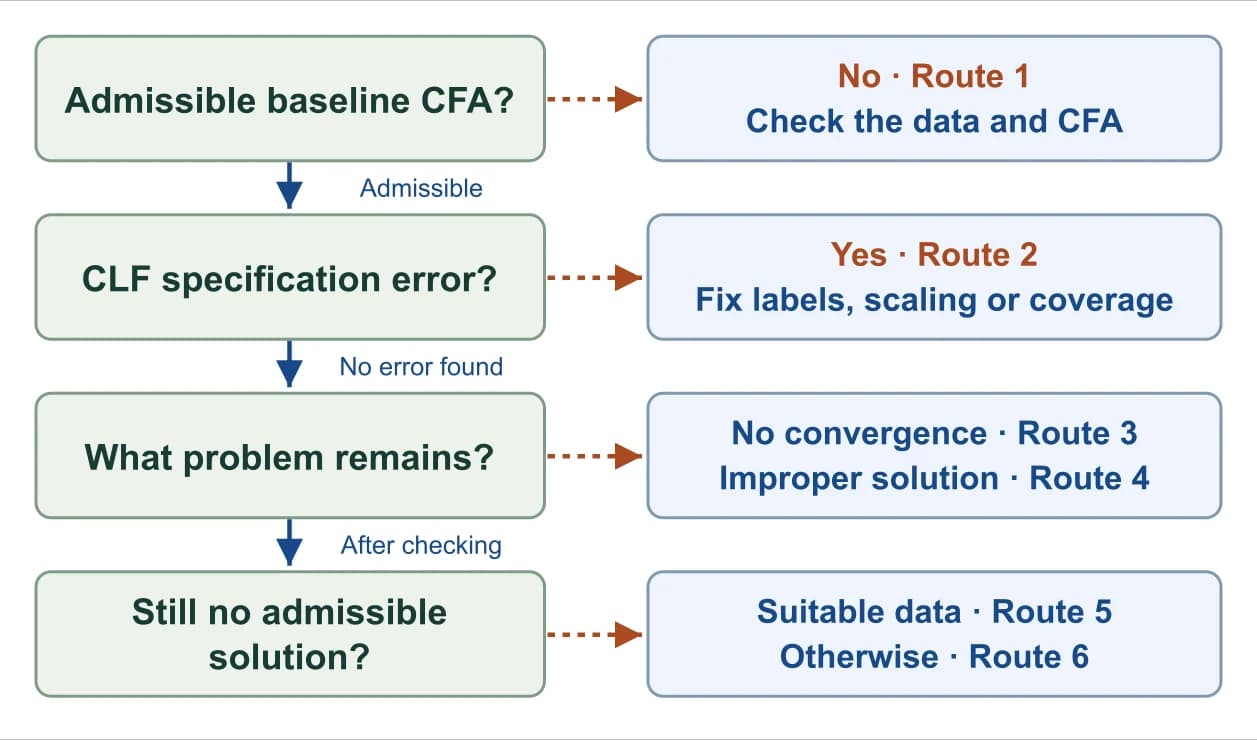
When an AMOS model with a common latent factor (CLF) fails, use the warning to decide what to check next. The diagram shows six possible responses. Four hypothetical cases and reporting templates show how to justify a change, evaluate the revised solution and decide when to stop.
Start readingIdentify exactly what failed
Save the original output and the substantive CFA or SEM for comparison. If AMOS flags a negative estimate or names a matrix, use the guide to reading signs and matrix warnings to locate the problem before consulting the table.
AMOS may print interim estimates when it reaches the iteration limit (Amos Development Corporation, n.d.-b). A converged model still needs an admissibility check (Amos Development Corporation, n.d.-c).
| What AMOS reports | What to inspect | Where to start |
|---|---|---|
| The substantive model already has an improper solution | Item coding, missing-value rules, the input matrix and the substantive specification. | Approach 1. Examine boundary estimates with approach 4. |
| Iteration limit reached or failed convergence | Scaling and identification first, then the starting values and iteration history. | Approaches 2 and 3. |
| Negative variance or an estimated covariance matrix warning | Find the offending variance or correlation and identify the matrix named in the warning. | Approach 4, with approach 1 if the input matrix is affected. |
| A negative covariance with no other warning | Check the corresponding correlation and whether the sign is substantively plausible. | A covariance can be negative. Investigate if the matrix or the estimates raise other concerns. |
| The CLF still yields no interpretable solution | Check whether the existing data contain credible marker or multi-method information. | Approach 5 where feasible, otherwise approach 6. |
A decision path for choosing an approach
- Is the substantive model admissible? If it already has a problem, start with the data and measurement model.
- Is the CLF specified as intended? Check the labels, factor scaling, assumptions and item coverage.
- Did the model converge? Investigate identification and numerical search when it did not. Examine variances and matrix warnings when it did.
- Does the adjusted model support an interpretation? Use another measured source of method information if one is available. Otherwise assess conditional sensitivity or report what remains unresolved.
1. Resolve data or measurement problems first
Rerun the substantive CFA without the CLF. Confirm the dataset and variable names, missing-value codes, scale directions and reverse scoring. Check unexpected duplicates, near-constant items and correlations so high that the indicators may carry essentially the same information. Investigate these findings using the questionnaire and data records.
If the warning concerns the input matrix, inspect how it was constructed and how missing data were handled. Pairwise deletion can produce covariances calculated from different subsets of cases and affect whether the resulting matrix is positive definite (Arbuckle, 2014).
Review the AMOS model notes, loadings, variances and factor correlations. Combine constructs, introduce a higher-order factor or free cross-loadings only when the measurement theory supports the change. After validating a correction, refit the baseline and compare any CLF version on the same data under comparable estimation conditions.
2. Audit factor scaling and CLF constraints
Make a short specification sheet. Identify the items with method loadings fixed at zero, the loadings sharing a label and those estimated separately. Check how the CLF is scaled, whether it is allowed to covary with the substantive factors and how its mean is handled when the model includes a mean structure. In AMOS, accidentally reusing a label can tie a substantive loading to a method loading.
With one common method loading and consistent scale, fixing the CLF variance at 1 and estimating that loading can represent the same covariance contribution as fixing all its loadings at 1 and estimating a nonnegative CLF variance. The equivalence concerns the implied covariance under the stated model. Identification still needs to hold, and the two parameterizations can behave differently near a boundary.
Limit CLF coverage to a subset of items only if the design provides a reason, such as a distinct rater, occasion or response mode. Every extra free method parameter requires information that distinguishes it from the other parameters. See the AMOS guide to the one-factor CFA and CLF specifications for the baseline setup.
3. Check the numerical search after checking identification
For an identified and plausible specification, compare several defensible starts. In AMOS, mCLF:0.18 supplies a parameter label and an initial value while allowing estimation. A repeated label imposes equality. Entering only 0.18 fixes the parameter to that number. The iteration setting is available via View → Analysis Properties → Numerical → Iteration limit. Consider increasing it if the iteration history suggests the algorithm is still making progress.
Compare the estimation criterion, standard errors and substantive estimates across completed runs. If runs fit about equally well yet yield very different method variance shares, review the identification and constraints. Use the CLF scaling choices and worked variance example to check whether the method contribution itself changed. Standardizing each item separately before imposing equality on the raw loadings can change the model.
4. Evaluate negative variances and boundary estimates
If the substantive model already has a negative variance, start with approach 1. If the warning followed the addition of the CLF, check its specification with approach 2. Consider sampling variation as well as misspecification. A small negative estimate or an interval spanning zero is insufficient grounds for fixing the parameter (Kolenikov & Bollen, 2012).
Fix a variance at zero only when there is a substantive or statistical rationale, and make the resulting assumption explicit. Assess how the change affects the estimates you plan to interpret. For a likelihood-ratio test with a null parameter on the admissible boundary, the usual chi-square reference distribution can fail. The appropriate test depends on the constraints and model (Stoel et al., 2006).
AMOS also supports Bayesian estimation by MCMC. Inspect convergence and fit, document the priors and check sensitivity to meaningful alternatives. For a variance assigned a nonnegative prior, a positive posterior estimate must be interpreted in light of that prior. An estimation change alone cannot resolve a poorly identified measurement model.
5. Consider a model that uses other method information
A CLF uses assumptions to separate method covariance from substantive covariance. When the design contains a credible marker, ratings from multiple sources or a structured multi-occasion measurement, those measurements may support a different specification. The choice depends on what the recorded data can identify.
| Option | Information required | What to establish first |
|---|---|---|
| CFA marker | A recorded marker with a substantive case for being unrelated to the focal constructs and a plausible connection to the method effect. | A small observed correlation alone is insufficient. Explain the marker selection and the assumptions of the adjusted model. |
| Multitrait–multimethod model | Observations of several traits using genuinely distinct methods, with sufficient overlap to estimate trait and method contributions. | A second date alone does not guarantee a distinct method. Specify what changed across methods and check identification. |
| Additional measurement designed around the problem | New observations from another source, condition or collection design, with access and resources to collect them. | A larger sample may improve precision. It cannot by itself identify an underidentified model or justify a poor equality constraint. |
The CFA marker approach is described by Williams et al. (2010). Simmering et al. (2015) discuss marker selection and reporting. Podsakoff et al. (2024) review design and statistical approaches to common method bias.
6. Report conditional sensitivity or an unresolved adjustment
Consider sensitivity analysis when the substantive model is admissible and there is a defensible range of assumed method loadings. Follow the fixed-loading AMOS workflow for comparing target effects. Use the results to describe how the conclusion changes across the tested range.
Report failed scenarios and interpret effects only from admissible runs. State that any bootstrap interval is conditional on the fixed loading in that scenario.
If no adjusted model can be interpreted, report the admissible substantive model, the safeguards used during data collection and the reason for stopping. The extent of remaining method bias is uncertain (Podsakoff et al., 2024).
Read the Harman test and single-factor CFA within the limits of each assessment (Aguirre-Urreta & Hu, 2019).
Apply the decision path to four cases
These cases are hypothetical. Each isolates one feature of the AMOS output that changes the next step.
| Case | First response | What to report |
|---|---|---|
| A CLF loading and a substantive loading share an accidental label | Approach 2. Restore the intended labels and rerun the baseline-compatible model. | Document the accidental equality and the corrected specification. |
| One residual variance is negative in the substantive CFA before adding the CLF | Approach 1, then 4. Review item coding, factor structure and uncertainty around that variance. | Report the baseline issue and the evidence for any retained constraint. |
| Different starts give similar fit but very different method variance estimates | Approaches 2 and 3. Compare scaling, equality constraints and identification. | Show how the partitions differ and identify which substantive estimates remain stable. |
| The CLF stays improper and the questionnaire has no suitable marker | Approach 5 if other credible method information exists. Otherwise use approach 6. | Describe what can be assessed conditionally and the remaining limitation. |
| Shortcut | What to do instead |
|---|---|
| Fix every negative estimate to zero | Locate the offending parameter and investigate sampling uncertainty, measurement and specification. |
| Lower the CLF variance to weaken the method effect | Check the factor scale and the resulting loading squared times variance. |
| Delete items or cases until the output looks acceptable | Document any correction or exclusion using substantive grounds and a rule that can be audited. |
| Change the estimator or software as soon as a warning appears | Identify the original problem. Report how the new estimation assumptions affect it. |
| Report a single convenient fixed loading | Specify and justify a range, then report all tested scenarios. |
| Use Harman to declare that CMB is absent | Describe the attempted adjustment and the uncertainty that remains. |
Document the changes and report what the data support
- Save the baseline, original CLF specification and corresponding outputs.
- Record each justified change and which parameter or assumption it addresses.
- Report convergence, admissibility and fit alongside the substantive estimates. Compare the estimates across admissible versions.
- State what remains uncertain and how it affects the substantive conclusion.
Reporting language you can adapt
- Technical correction. The original CLF run constrained two paths to equality because their labels were identical. We restored the intended labels and refitted the model on the same sample.
- Change in method specification. We restricted the method factor to the items collected under [conditions]. The decision was based on [design evidence]. We compared [estimates] with the baseline CFA.
- Boundary estimate or Bayesian analysis. We assessed [variance or other parameter] at its admissible boundary using [model or method]. Report the justification, estimation assumptions and the sensitivity of [target estimate].
- Unresolved adjustment. The fitted CLF models yielded [documented problem]. We report the baseline estimates and [design evidence or conditional sensitivity]. The extent of remaining method bias is uncertain.
Conclusion
Tie each change to a specific warning or to evidence from the measurement design. Document the baseline, the checks on the revised solution and the reason for stopping if the data cannot support a CLF adjustment.
How to cite this guide
In the text, use (Le Minh, 2026) or Le Minh (2026).
Reference list entry
Le Minh. (2026, November 20). When an AMOS CLF model fails: six ways to respond. SmartPLS Lê Minh. https://smartplsleminh.com/en/bai-viet/huong-xu-ly-clf-bi-loi-nghiem-amos
References
- Aguirre-Urreta, M. I., & Hu, J. (2019). Detecting common method bias: Performance of the Harman’s single-factor test. ACM SIGMIS Database: The DATABASE for Advances in Information Systems, 50(2), 45–70.
- Amos Development Corporation. (n.d.-a). Features.
- Amos Development Corporation. (n.d.-b). Iteration limit.
- Amos Development Corporation. (n.d.-c). The following variances are negative.
- Amos Development Corporation. (n.d.-d). To provide initial values for parameters.
- Arbuckle, J. L. (2014). IBM SPSS Amos 23 user’s guide. IBM.
- Chen, F., Bollen, K. A., Paxton, P., Curran, P. J., & Kirby, J. B. (2001). Improper solutions in structural equation models: Causes, consequences, and strategies. Sociological Methods & Research, 29(4), 468–508.
- Kolenikov, S., & Bollen, K. A. (2012). Testing negative error variances: Is a Heywood case a symptom of misspecification? Sociological Methods & Research, 41(1), 124–167.
- Podsakoff, P. M., Podsakoff, N. P., Williams, L. J., Huang, C., & Yang, J. (2024). Common method bias: It’s bad, it’s complex, it’s widespread, and it’s not easy to fix. Annual Review of Organizational Psychology and Organizational Behavior, 11, 17–61.
- Richardson, H. A., Simmering, M. J., & Sturman, M. C. (2009). A tale of three perspectives: Examining post hoc statistical techniques for detection and correction of common method variance. Organizational Research Methods, 12(4), 762–800.
- Simmering, M. J., Fuller, C. M., Richardson, H. A., Ocal, Y., & Atinc, G. M. (2015). Marker variable choice, reporting, and interpretation in the detection of common method variance: A review and demonstration. Organizational Research Methods, 18(3), 473–511.
- Stoel, R. D., Galindo Garre, F., Dolan, C., & van den Wittenboer, G. (2006). On the likelihood ratio test in structural equation modeling when parameters are subject to boundary constraints. Psychological Methods, 11(4), 439–455.
- Williams, L. J., Hartman, N., & Cavazotte, F. (2010). Method variance and marker variables: A review and comprehensive CFA marker technique. Organizational Research Methods, 13(3), 477–514.