
The PRISMA 2020 Workflow: From the Research Question to a Verifiable Flow Diagram
PRISMA 2020 supports transparent systematic-review reporting, but checklists and flow diagrams cannot replace protocols, searches, screening decisions or synthesis methods.
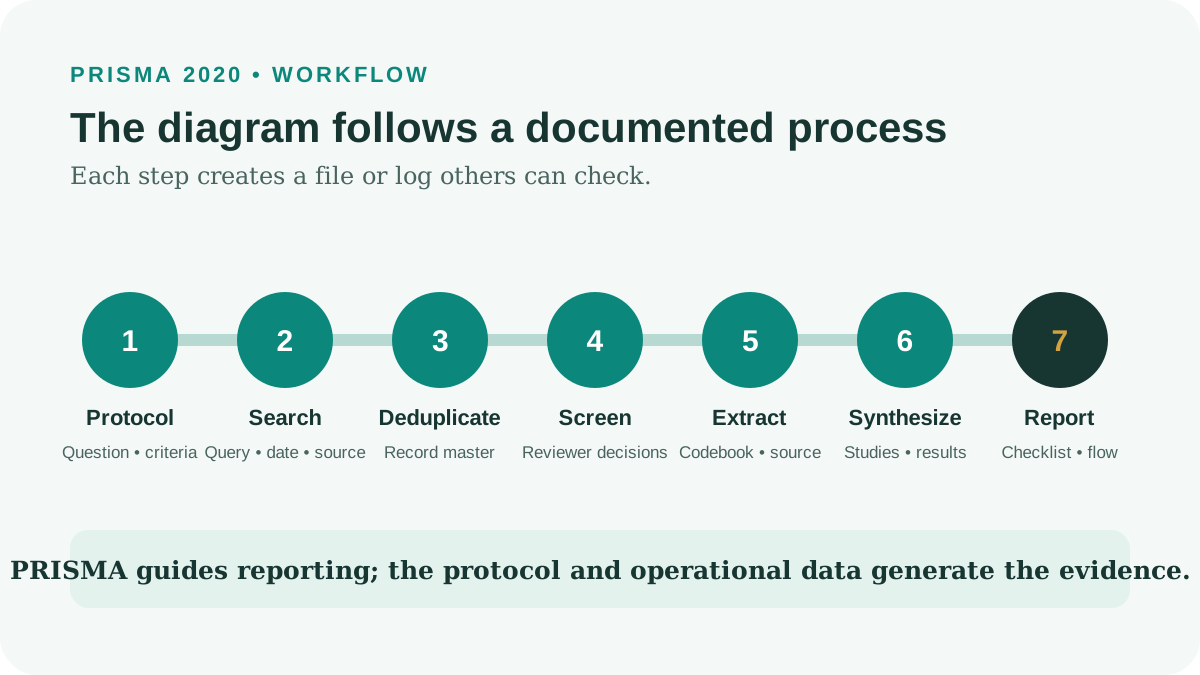
PRISMA 2020 guides reporting, not review conduct. Every flow count should be traceable to search files, deduplication logs, screening decisions, full-text exclusions and report–study links.
1. What is PRISMA 2020 for?
PRISMA means Preferred Reporting Items for Systematic Reviews and Meta-Analyses. The 2020 version specifies minimum reporting of rationale, methods and findings. Core materials include a 27-item checklist, expanded checklist, abstract checklist and flow templates (Page, McKenzie, et al., 2021).
Interpret “reporting” correctly. PRISMA helps assess completeness and transparency; it does not select databases, risk-of-bias tools or synthesis models. Explain those review-specific methodological choices through a protocol and specialized guidance (Page, Moher, et al., 2021).
| Component | Scope | Source |
|---|---|---|
| PRISMA 2020 checklist | 27 systematic-review reporting items | Page, McKenzie, et al. (2021) |
| Flow diagram | 4 templates by review type and identification sources | PRISMA (n.d.-b) |
| PRISMA-S | 16 search-reporting items | Rethlefsen et al. (2021) |
State that the review followed a prespecified protocol and was reported according to PRISMA 2020. Methods must still describe questions, eligibility, searches, screening, extraction, risk of bias and synthesis.
2. Choose appropriate checklists and extensions
PRISMA 2020 mainly addresses intervention-effect reviews. Other systematic reviews can use it while checking relevant extensions. PRISMA recommends the main guideline together with design- and evidence-specific extensions (PRISMA, n.d.-c; Page, Moher, et al., 2021).
Meta-analysis is not required for a systematic review. Without pooling, describe study grouping, synthesis methods and each synthesis in sufficient detail to assess conclusions (Page, Moher, et al., 2021).
| Product | Guidance | Avoid |
|---|---|---|
| Systematic review | PRISMA 2020 and expanded checklist | Submitting only a flow diagram |
| Protocol | PRISMA-P | Writing a protocol after learning results |
| Search strategy | PRISMA-S alongside PRISMA 2020 | Listing isolated keywords only |
| Scoping review | PRISMA-ScR | Calling every descriptive review systematic |
| Diagnostic, IPD, harms or network meta-analysis | PRISMA 2020 plus the relevant extension | Ignoring evidence-specific requirements |
3. Fix the question, eligibility and protocol
A protocol records rationale, objectives and planned methods before the team fully knows eligible-study results. PRISMA-P provides a 17-item protocol checklist (Moher et al., 2015); its explanation details each item’s rationale and requirements (Shamseer et al., 2015).
For intervention reviews, PICO defines population, intervention, comparator and outcome. The first three often underpin eligibility; prespecify outcomes, but they are not always exclusion criteria. Excluding a study for not reporting an outcome differs from excluding one that never measured it (McKenzie et al., 2024; Page, Moher, et al., 2021).
Other fields may need different frameworks. Match the framework to the question and operational inclusion/exclusion rules that two reviewers can apply consistently to one report.
| Component | Advance decision | Record to preserve |
|---|---|---|
| Question | Population, phenomenon/intervention, outcome and context | Question version and approval date |
| Criteria | Design, dates, languages and publication status | Criteria dictionary and borderline examples |
| Sources | Databases, registers, websites and citation searching | Platform, coverage and search date |
| Screening | Reviewer count, independence and disagreement resolution | Forms and conflict log |
| Synthesis | Extracted variables, risk of bias and analysis methods | Extraction form and codebook |
Protocol changes are not inherently unreliable. Undisclosed or result-informed changes create risk. Log each amendment’s content, date, reason and effect, and distinguish planned from performed methods.
4. Design reproducible searches
Record database and platform, execution date, date coverage, verbatim queries, limits, filters and supplementary methods. MEDLINE via PubMed and Ovid are not equivalent descriptions because syntax, fields and term mapping differ. PRISMA-S has 16 items supporting assessment and reproduction (Rethlefsen et al., 2021).
Build a concept matrix
List synonyms, spelling variants and controlled terms for each concept.
Develop the master query
Use OR within concepts and AND between concepts. Test against known relevant papers.
Translate syntax
Adapt fields, truncation, quotes and proximity operators for each platform.
Run and timestamp
Save date, count, export format, filename and verbatim query. Preserve each update rather than overwriting.
Supplement searches
Specify backward/forward citation searching, websites or expert contact.
Update before submission
Describe updates and integration of new batches.
Reporting example in English
We searched [database] through [platform] from [start, if any] to [last date]. Controlled and free-text terms addressed [concepts]. Verbatim queries, filters and source counts appear in Appendix [X]. Supplementary [citation/web/expert] searches occurred on [date]. Language, date and document limits were justified by [reasons].
5. Manage records and deduplicate
Preserve each source export as a separate batch before merging, with source ID, date, count and identifiers. This supports identification-branch counts.
Do not treat deduplication as a black box. Report tools, versions, matching fields and manual checks. Missing DOIs do not prove records differ, and similar titles do not prove duplicates. Compare titles, authors, years, publication sources, pages and identifiers together (Rethlefsen et al., 2021).
| Field | Example | Purpose |
|---|---|---|
| batch_id | SCOPUS_2026-10-20 | Trace source and export batch |
| record_id | Unique internal identifier | Link processing stages |
| duplicate_of | Retained record ID | Audit deduplication decisions |
| decision_timestamp | Date/time and reviewer | Version decision records |
Records screened equal identified records minus duplicates and other prescreening removals. Trace every term to management tables rather than reconstructing counts from memory.
6. Screen and record exclusion reasons
PRISMA 2020 requests reviewer counts per record/report, independence, disagreement handling and automation roles (Page, McKenzie, et al., 2021). It does not assume one staffing arrangement for all projects; describe actual practice so readers can assess missed or misclassified evidence (Page, Moher, et al., 2021).
Pilot eligibility criteria
Reviewers independently apply criteria to a small common set, compare decisions and resolve ambiguities before full screening.
Screen records
Save include, exclude or uncertain decisions and their history.
Retrieve full text
Separate unavailable reports from retrieved but ineligible reports.
Assess full text
Assign each excluded report one main reason from a defined list.
Resolve disagreements
Record the final decision, conflict and any clarified rule.
Use criterion-specific labels such as wrong population, intervention/exposure, design or context. Distinguish unmeasured outcomes from measured but unreported results.
7. Distinguish records, reports and studies
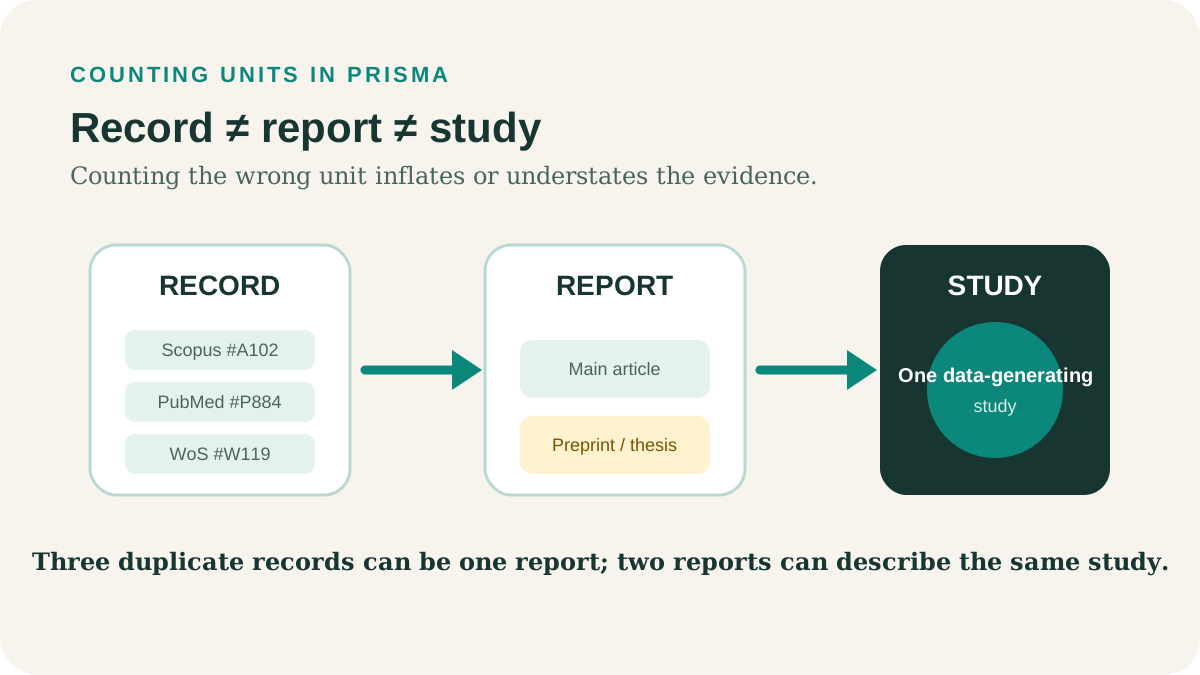
A record is an indexed title, abstract or entry for a report. A report supplies study information, such as an article, preprint, thesis or registration. A study is the actual data-generating investigation. One study may have several reports and one report multiple duplicate records (Page, Moher, et al., 2021).
| Unit | Example | Common pitfall |
|---|---|---|
| Record | One Scopus entry | The same report appears in several sources |
| Report | Journal article, preprint or thesis | Several reports describe one study |
| Study | One original investigation or dataset | Counting reports as studies inflates evidence |
Use study_id and report_id. Link shared samples, trial registrations or collection rounds before extraction and study counting.
8. Extraction, risk of bias and synthesis
PRISMA extends beyond inclusion. Report extractor counts, independence, author confirmation, sought variables, risk-of-bias tools and synthesis methods (Page, Moher, et al., 2021).
Pilot extraction forms. Define field types, units, measurement times and source reports. Prespecify selection among multiple eligible results. For derived values, save formulas, inputs and the person responsible.
For each synthesis, state eligible studies and grouping reasons. Meta-analyses need pooled estimates, precision and appropriate heterogeneity measures. Without pooling, describe synthesis methods and avoid vote counting by statistical significance (Page, Moher, et al., 2021).
| Block | Content | Control |
|---|---|---|
| Study characteristics | Design, context, sample and timing | Codebook and permitted values |
| Outcome/theme | Definition, instrument and results | Source-page links |
| Risk of bias | Domains, judgments and reasons | Design-appropriate tool |
| Synthesis | Study groups and data used | Trace results to source reports |
It documents the literature pathway, not low bias, correct extraction or defensible synthesis.
9. Build the diagram and reconcile arithmetic
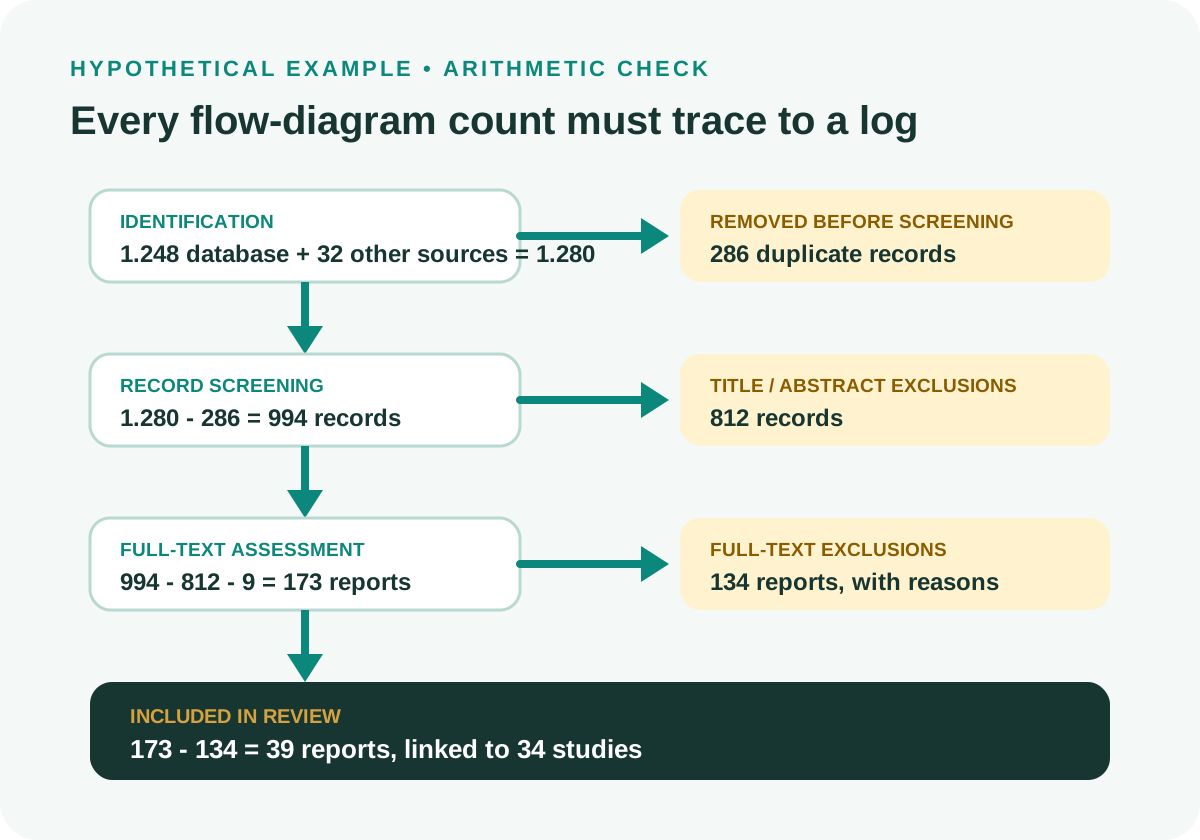
Count identified records, prescreening removals, screened records, reports sought/unavailable/excluded with reasons, and included studies/reports. PRISMA provides four templates for new/updated reviews and identification with/without additional sources beyond databases/registers (PRISMA, n.d.-b).
The following counts are hypothetical illustrations, not an actual review.
| Step | Hypothetical count | Reconciliation |
|---|---|---|
| Database records | 1.248 | Sum of exports |
| Other-source records | 32 | Supplementary search log |
| Duplicate records | 286 | 1.248 + 32 - 286 = 994 |
| Title/abstract exclusions | 812 | 994 - 812 = 182 reports sought |
| Reports not retrieved | 9 | 182 - 9 = 173 reports assessed |
| Full-text report exclusions | 134 | Reasons must sum to 134 |
| Included reports | 39 | 173 - 134 = 39 |
| Included studies | 34 | 39 reports linked to 34 study_id values |
Choose the PRISMA 2020 template by two decisions: new or updated review, and identification using sources beyond databases/registers. Do not simplify away reports not retrieved or reports excluded.
10. Complete reporting and the handover package
Check reporting while writing, not only at submission. Give a page/section for every item or explain inapplicability. Official materials provide the 27-item and expanded checklists (PRISMA, n.d.-a). Read Explanation and Elaboration for rationale, essentials and examples (Page, Moher, et al., 2021).
| File | Content | Role |
|---|---|---|
| protocol | Plan and amendments | Distinguish planned from post hoc methods |
| search-log | Sources, queries, dates and counts | Reproduce searches |
| records-master | Records, sources and deduplication | Reconcile identification |
| screening-log | Reviewer decisions | Reconcile screening |
| full-text-exclusions | Excluded reports and reasons | Populate the exclusion branch |
| study-report-map | report_id and study_id links | Count studies accurately |
| PRISMA-checklist | Reporting location for every item | Assess completeness |
Reporting example in English
This review was reported according to PRISMA 2020 (Page, McKenzie, et al., 2021). Its protocol was [registered/archived] at [platform, ID/URL] on [date]. Searches covered [databases/platforms] through [date]; full queries appear in Appendix [X]. Removing [n] duplicates and [n] prescreening records left [n] title/abstract records. [Number] reviewers screened [independently/nonindependently], resolving disagreements through [procedure]. Full-text assessment covered [n] reports, excluded [n] for defined reasons, and included [n] studies in [n] reports.
11. Common errors
| Weak practice | Problem | Correction |
|---|---|---|
| The study used the PRISMA method | PRISMA does not specify all conduct | Describe protocol, search, screening, extraction and synthesis |
| Only drawing a diagram | Does not cover 27 items | Complete the checklist with page locations |
| Not saving queries | Searches cannot be reproduced | Preserve queries, dates, platforms, filters and counts |
| Counting papers as studies | One study can have several reports | Create study_id and report_id |
| Combining unavailable and ineligible reports | Different stages and statuses | Keep retrieval_status and full_text_decision separate |
| Excluding as irrelevant | Does not identify the failed criterion | Use specific reason categories |
| Inventing counts at project end | Arithmetic errors and lost provenance | Generate counts from record and screening tables |
| Not reporting AI/automation | Unclear which records were affected | State tools, versions, roles and human verification |
12. Submission checklist
- Report the protocol, registration and all amendments.
- Make eligibility reproducibly operational.
- Name each source’s platform and last search date.
- Include verbatim queries in an appendix.
- Describe deduplication tools, versions, matching fields and checks.
- State reviewer counts, independence and conflict resolution.
- Separate unavailable reports from full-text exclusions.
- Assign one main reason per full-text exclusion.
- Count records, reports and studies correctly.
- Reconcile diagram counts, decision tables and subtraction.
- Make extraction, bias assessment and synthesis assessable.
- Describe AI/automation and human verification.
- Give reporting locations for all checklist items.
- Match the diagram template to review type and sources.
Conclusion
A trustworthy PRISMA workflow starts with a protocol, operational criteria and preserved queries rather than filling diagram boxes. Record, report and study tables generate counts and document decisions.
Checklists and diagrams report documented work. Traceable boxes and explained protocol changes let readers assess searches, study selection and reporting completeness.
References
- Page, M. J., McKenzie, J. E., Bossuyt, P. M., Boutron, I., Hoffmann, T. C., Mulrow, C. D., Shamseer, L., Tetzlaff, J. M., Akl, E. A., Brennan, S. E., Chou, R., Glanville, J., Grimshaw, J. M., Hróbjartsson, A., Lalu, M. M., Li, T., Loder, E. W., Mayo-Wilson, E., McDonald, S., ... Moher, D. (2021). The PRISMA 2020 statement: An updated guideline for reporting systematic reviews. BMJ, 372, n71.https://doi.org/10.1136/bmj.n71
- Page, M. J., Moher, D., Bossuyt, P. M., Boutron, I., Hoffmann, T. C., Mulrow, C. D., Shamseer, L., Tetzlaff, J. M., Akl, E. A., Brennan, S. E., Chou, R., Glanville, J., Grimshaw, J. M., Hróbjartsson, A., Lalu, M. M., Li, T., Loder, E. W., Mayo-Wilson, E., McDonald, S., ... McKenzie, J. E. (2021). PRISMA 2020 explanation and elaboration: Updated guidance and exemplars for reporting systematic reviews. BMJ, 372, n160.https://doi.org/10.1136/bmj.n160
- PRISMA. (n.d.-a). PRISMA 2020 checklist.https://www.prisma-statement.org/prisma-2020-checklist
- PRISMA. (n.d.-b). PRISMA 2020 flow diagram.https://www.prisma-statement.org/prisma-2020-flow-diagram
- PRISMA. (n.d.-c). PRISMA extensions.https://www.prisma-statement.org/extensions
- McKenzie, J. E., Brennan, S. E., Ryan, R. E., Thomson, H. J., Johnston, R. V., & Thomas, J. (2024). Chapter 3: Defining the criteria for including studies and how they will be grouped for the synthesis. In J. P. T. Higgins, J. Thomas, J. Chandler, M. Cumpston, T. Li, M. J. Page, & V. A. Welch (Eds.), Cochrane handbook for systematic reviews of interventions (Version 6.5). Cochrane.https://training.cochrane.org/handbook/current/chapter-03
- Moher, D., Shamseer, L., Clarke, M., Ghersi, D., Liberati, A., Petticrew, M., Shekelle, P., Stewart, L. A., & PRISMA-P Group. (2015). Preferred reporting items for systematic review and meta-analysis protocols (PRISMA-P) 2015 statement. Systematic Reviews, 4, 1.https://doi.org/10.1186/2046-4053-4-1
- Rethlefsen, M. L., Kirtley, S., Waffenschmidt, S., Ayala, A. P., Moher, D., Page, M. J., Koffel, J. B., & PRISMA-S Group. (2021). PRISMA-S: An extension to the PRISMA Statement for reporting literature searches in systematic reviews. Systematic Reviews, 10, 39.https://doi.org/10.1186/s13643-020-01542-z
- Shamseer, L., Moher, D., Clarke, M., Ghersi, D., Liberati, A., Petticrew, M., Shekelle, P., Stewart, L. A., & PRISMA-P Group. (2015). Preferred reporting items for systematic review and meta-analysis protocols (PRISMA-P) 2015: Elaboration and explanation. BMJ, 350, g7647.https://doi.org/10.1136/bmj.g7647
Methodological note: This is general reporting and workflow guidance. Fields, questions and evidence types may require specialist guidance. All example counts are hypothetical.