
Testing Heteroskedasticity and Using Robust SEs in SPSS
Heteroskedasticity invalidates conventional OLS standard errors; it does not automatically bias OLS coefficients. A common response is to use robust standard errors for inference and revisit the specification.
Use residual-versus-fitted plots to inspect patterns and Breusch–Pagan/Koenker or White tests for formal assessment. When heteroskedasticity is present, report HC3 or an appropriate estimator; Levene’s test is not a substitute for regression error-variance diagnostics.
Heteroskedasticity: separate estimation and inference
- Residuals
Inspect plots and spread patterns
- Diagnostics
Check specification and influential cases
- Standard errors
Consider appropriate robust SEs
- Interpretation
Report the inference procedure
Conceptual diagram. Robust SEs do not fix functional form, endogeneity or measurement quality.
Source: Lê Minh · Conceptual illustration, not software output.1. What does heteroskedasticity affect?
Homoskedasticity requires constant Var(εᵢ|X). When variance changes with X or fitted values, OLS may remain unbiased under the other assumptions, but conventional standard errors, t/F tests and CIs can be incorrect (MacKinnon & White, 1985; White, 1980).
Levene’s test examines variance equality between groups in t-tests/ANOVA; it does not replace regression residual heteroskedasticity tests.
| Tool | Purpose |
|---|---|
| Residual plot | Inspect fan shapes, nonlinearity and outliers |
| Breusch–Pagan/Koenker | Variance related to predictors/fitted values |
| White | More general patterns; also sensitive to misspecification |
| HC3 robust SE | Correct SEs/CIs while retaining OLS coefficients |
2. SPSS workflow
Fit the original regression
Save ZPRED, ZRESID and unstandardized residuals as needed.
Plot residuals
Inspect residual spread over fitted values and nonlinear patterns.
Run diagnostic tests
Use BP/modified BP/White where supported; older versions may need syntax or another tool.
Review the specification
Check omitted variables, functional form, interactions and outliers.
Use robust estimation
Use HC3 or a suitable alternative; interpret robust SEs/CIs rather than the old conventional SE table.
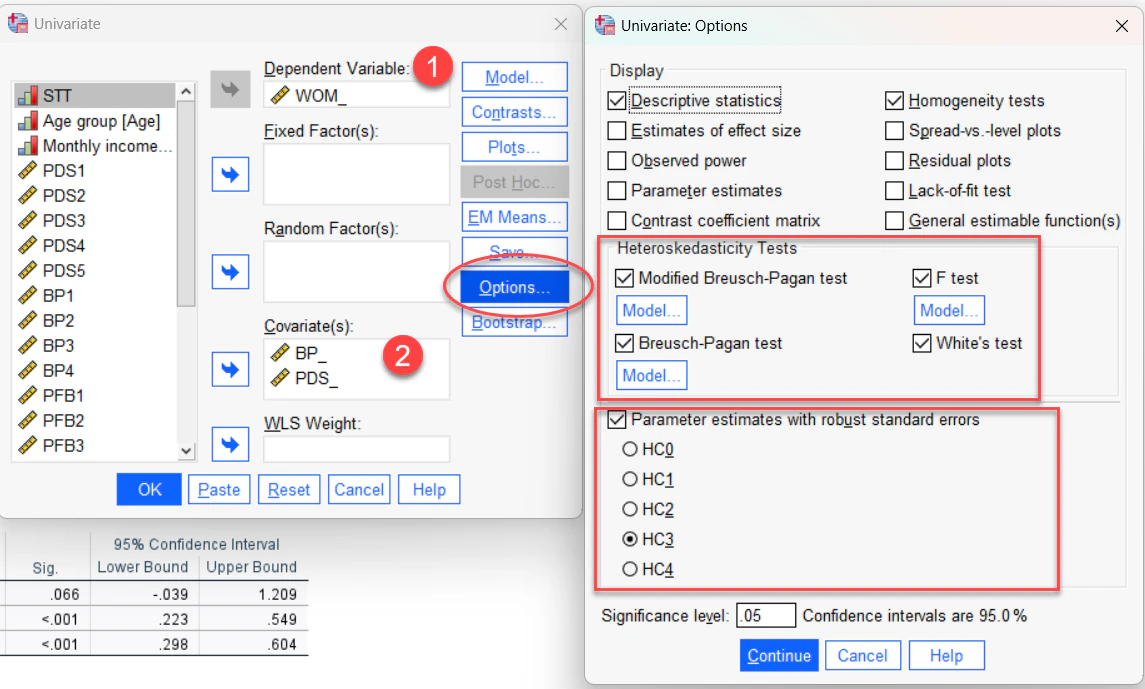
3. Interpret the null hypothesis correctly
H0 for BP/White tests is homoskedasticity under the tested specification. A small p-value supports heteroskedasticity or misspecification; a large p-value means only that it was not detected, particularly in small samples (Breusch & Pagan, 1979; White, 1980).
White’s test uses many degrees of freedom with numerous predictors, squares and cross-products; power or estimation stability can suffer. Modified BP/Koenker tests and robust SEs can provide complementary information.
HC3 corrects the estimator covariance under heteroskedasticity. It does not fix omitted variables, endogeneity, influential outliers or an incorrect functional form.
4. Reporting template
Reporting example in English
The residual plot showed [description]. Breusch–Pagan χ²(df) = [ ], p = [ ]; White χ²(df) = [ ], p = [ ]. Given [evidence/no detected evidence] of heteroskedasticity, we report [HC3/OLS] SEs. The [X] coefficient was B = [ ], robust SE = [ ], 95% CI [ ; ], p = [ ].
- Do not use Levene’s test for regression residuals.
- Include a residual plot.
- State the test’s H0.
- Use robust SEs when appropriate.
- Check functional form and outliers.
- Do not interpret the previous OLS SE table after selecting HC3.
Conclusion
Heteroskedasticity assessment is one part of regression diagnostics. Robust SEs improve inference, but specification and data quality still need examination.
References
- Breusch, T. S., & Pagan, A. R. (1979). A simple test for heteroscedasticity. Econometrica, 47(5), 1287–1294.https://doi.org/10.2307/1911963
- White, H. (1980). A heteroskedasticity-consistent covariance matrix estimator and a direct test. Econometrica, 48(4), 817–838.https://doi.org/10.2307/1912934
- MacKinnon, J. G., & White, H. (1985). Some heteroskedasticity-consistent covariance matrix estimators. Journal of Econometrics, 29(3), 305–325.https://doi.org/10.1016/0304-4076(85)90158-7
Methodological note: BP/White/HC3 availability depends on the SPSS version. Report the actual version and syntax/menu used rather than assuming identical support in every release.