
Introducing Qualitative Analysis Using NVivo - The Five-Level QDA Method
A project containing many codes and queries can still lack an analytical argument. Nicholas H. Woolf and Christina Silver’s Qualitative Analysis Using NVivo: The Five-Level QDA Method addresses the gap between research purpose and software action (Woolf & Silver, 2018).
Start reading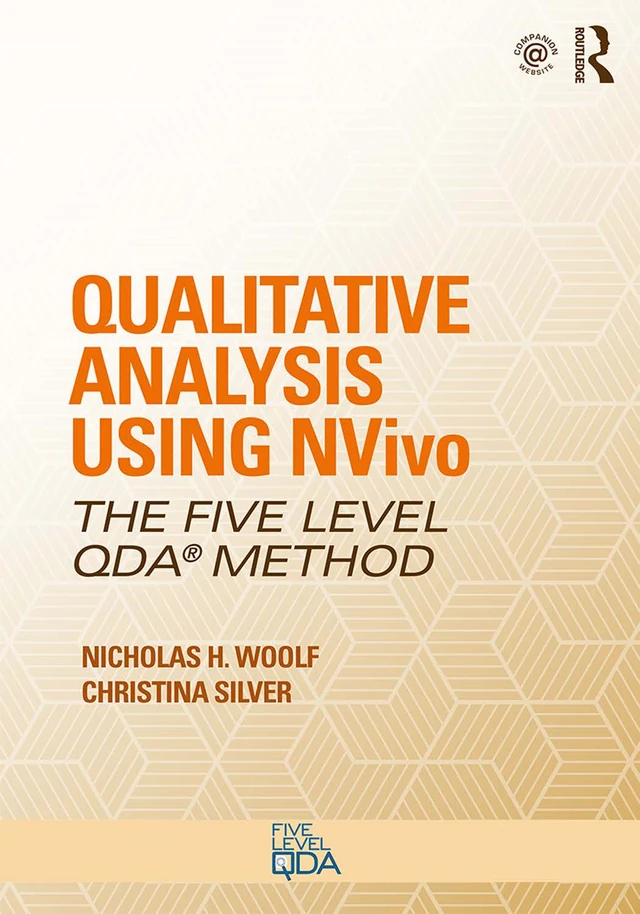
Qualitative Analysis Using NVivo
The Five-Level QDA® Method
Routledge · First edition · EnglishISBN 9781138743670Original book cover; the language and edition are identified alongside it.
Strategy before tactics
The contents establish strategies, objectives and analytical plans before translating tasks into software tools. Only afterward do they introduce NVivo orientation, architecture and practical translation. This distinguishes the book from a feature catalog.
One tool can serve different purposes; one purpose may require several operations. Running a query because it looks interesting differs from choosing it to examine a specific issue in the material. Confusing these can create a busy project with thin interpretation.
Make the connection visible
Before a session, state what you want to understand, identify a concrete analytical task and then choose a tool. Supervisors can similarly ask what the researcher is trying to learn rather than treating a growing code count as progress.
Exercise created by Lê Minh: for an illustrative interview excerpt, write three lines: intended understanding, relevant evidence and planned operation. If comparing groups, explain why available cases and attributes support that comparison. Successful matrix output does not itself answer the research question.
Finish with a memo describing what changed in your understanding. Recording only the number of new codes suggests returning to the original purpose.
Audience and companion reading
The book suits qualitative researchers seeking intentional NVivo use and instructors supporting analysis. The inspected edition carries a 2018 copyright, with 2017 release information; current interfaces require checking. It is distinct from Bazeley and Jackson’s Qualitative Data Analysis with NVivo. Choose Five-Level QDA when the main difficulty is connecting analytical purpose with tools, rather than simply finding another command.
Choose a companion reading
Continue with: Qualitative Data Analysis with NVivo (Second edition · 2013 · English).
Source and edition
Woolf, N. H., & Silver, C. (2018). Qualitative analysis using NVivo: The five-level QDA method. Routledge. https://doi.org/10.4324/9781315181660