
Advanced Mediation Analysis in CB-SEM
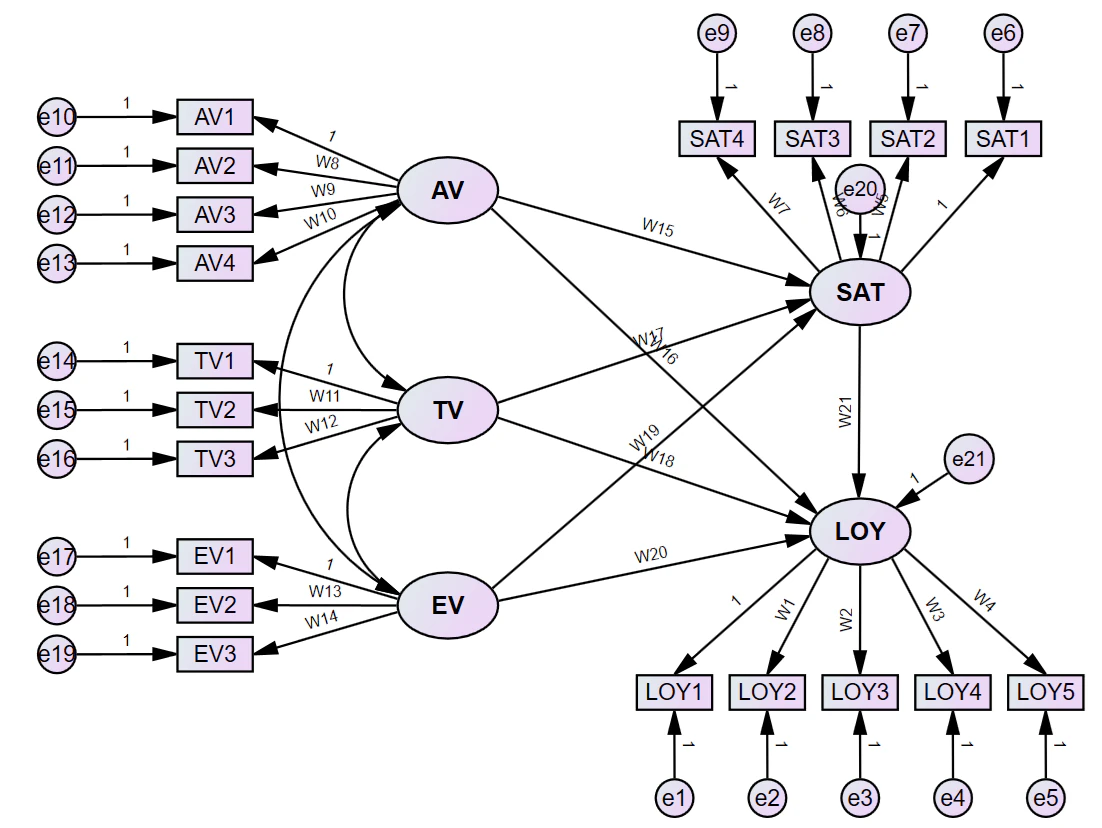
A total indirect effect can conceal indirect paths with opposite signs. Advanced analysis must define each specific indirect effect and bootstrap it directly.
For parallel or serial mediation, define each path product, report CIs and compare indirect effects using contrasts. Describe same-sign or opposite-sign direct/indirect effects; do not infer mediation from component-path p-values.
Mediation: distinguish direct and indirect effects
- Variable X
Predictor
- Mediator M
The hypothesised intervening pathway
- Outcome Y
Outcome
Conceptual diagram. Assess the indirect effect with uncertainty; VAF is descriptive.
Source: Lê Minh · Conceptual illustration, not software output.1. Total and specific indirect effects
| Type | Example | Meaning |
|---|---|---|
| Specific | X→M1→Y | A specific mechanism |
| Serial | X→M1→M2→Y | An ordered chain of mechanisms |
| Total indirect | Sum of all indirect paths | Total effect transmitted indirectly |
| Contrast | ab1 − ab2 | How much two mechanisms differ |
2. Do not decide from component-path p-values
A nonsignificant a or b under a Wald test does not preclude a bootstrap CI for a×b that excludes 0. Conversely, small p-values for both a and b do not guarantee a stable CI for a specific indirect effect (Preacher & Hayes, 2008).
The direct effect may be nonsignificant in indirect-only mediation; a significant total effect is also not a prerequisite for testing indirect effects (Zhao et al., 2010).
To claim M1 is a stronger mechanism than M2, bootstrap the contrast ab1 − ab2 rather than comparing separate p-values or estimates.
3. Complementary and competitive mediation
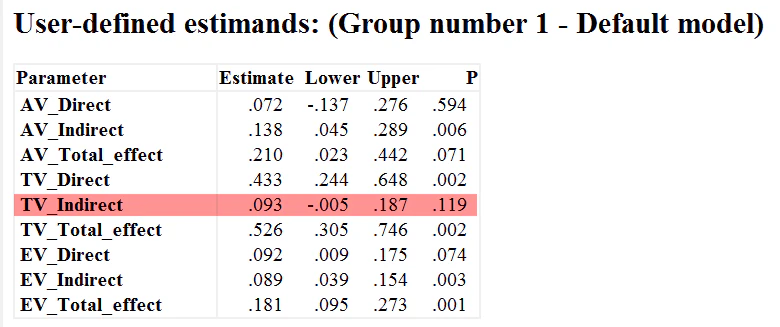
Direct and indirect effects with the same sign may be described as complementary mediation; opposite signs indicate competitive mediation. Opposing effects can yield a small total effect even when individual components are large.
Inspect the theoretical model, temporal order and mediator confounding. Cross-sectional data provide limited evidence for a temporally ordered mechanism.
4. Workflow for multiple mediators
Draw the required paths
Specify parallel, serial and direct paths according to the hypotheses.
Define estimands
Prespecify each product and contrast before estimation.
Bootstrap jointly
Use the same resamples to retain covariance between indirect effects.
Inspect each path’s CI
Report estimates, CIs, direct and total effects.
Assess sensitivity
Examine controls, reversed ordering and plausible alternative specifications.
5. Reporting template
Reporting example in English
The specific indirect effects through M1 and M2 were [ ], CI [ ; ], and [ ], CI [ ; ], respectively. The contrast ab1 − ab2 was [ ], CI [ ; ]. The direct effect was c′ = [ ]. The [same/opposite] signs of the direct and total indirect effects indicated [complementary/competitive] mediation. The [ ] design limited mechanistic inference to [ ].
- Separate specific from total indirect effects.
- Bootstrap contrasts when comparing mediators.
- Do not require a significant total effect first.
- Report direct/indirect effect signs.
- State the temporal order.
- Check alternative specifications.
Conclusion
Advanced mediation analysis concerns defining estimands and mechanisms, not accumulating p-values. Specific indirect effects and contrasts keep conclusions aligned with the research question.
References
- Zhao, X., Lynch, J. G., & Chen, Q. (2010). Reconsidering Baron and Kenny. Journal of Consumer Research, 37(2), 197–206.https://doi.org/10.1086/651257
- Preacher, K. J., & Hayes, A. F. (2008). Asymptotic and resampling strategies for indirect effects.https://doi.org/10.3758/BRM.40.3.879
Methodological note: Mediation in observational data depends on no-unmeasured-confounding assumptions for X–M, M–Y and X–Y. SEM does not automatically ensure these assumptions.