
Survey Questionnaire Design: From the Research Question to a Usable Pilot Instrument
A good questionnaire does not begin by typing questions into Google Forms. It begins with research objectives, the concepts to measure, and how respondents actually understand, remember, evaluate, and select answers.
This guide uses Total Survey Error as its control framework, then explains how to translate research questions into a measurement matrix, write questions using the survey-response model, check response scales and flow, and conduct expert reviews, cognitive interviews, usability tests, and pilots with stopping criteria.
1. What Should You Be Able to Do After This Article?
This guide helps you create a questionnaire clear enough for piloting rather than merely a plausible-looking question list. You will map objectives, concepts, variables, and questions; choose question types; design response scales; organize flow; and examine how participants understand and operate the questionnaire.
Before starting, identify research questions, target respondents, the intended collection mode, and constructs to measure. If each concept’s inclusions and exclusions remain undefined, do not write items yet. Peytcheva and Yan (2025) identify research objectives, concepts, measurement dimensions, and respondents’ vocabulary as central design inputs.
- Research questions and the unit of analysis are clear.
- The target population and eligibility criteria are defined.
- Each concept has a working definition and content scope.
- The mode is selected: web, telephone, paper, face-to-face, or mixed.
- Primary languages, devices, and response contexts are identified.
- Research ethics, consent, and data-protection plans are in place.
2. Control Framework: Three Error Layers in Total Survey Error
A questionnaire may be correctly worded yet produce weak data if it targets the wrong construct, intended respondents do not participate, or collection procedures alter responses. Total Survey Error treats survey quality as the product of multiple simultaneous error sources rather than sampling error alone (Groves et al., 2009).
For practical editing, monitor three layers. Content asks whether variables and items represent the intended concepts. The question layer examines understanding, recall, judgment, and response-scale use. Operations cover sampling frames, nonresponse, collection modes, routing, devices, data processing, and documentation. Check all three before launching the main survey.
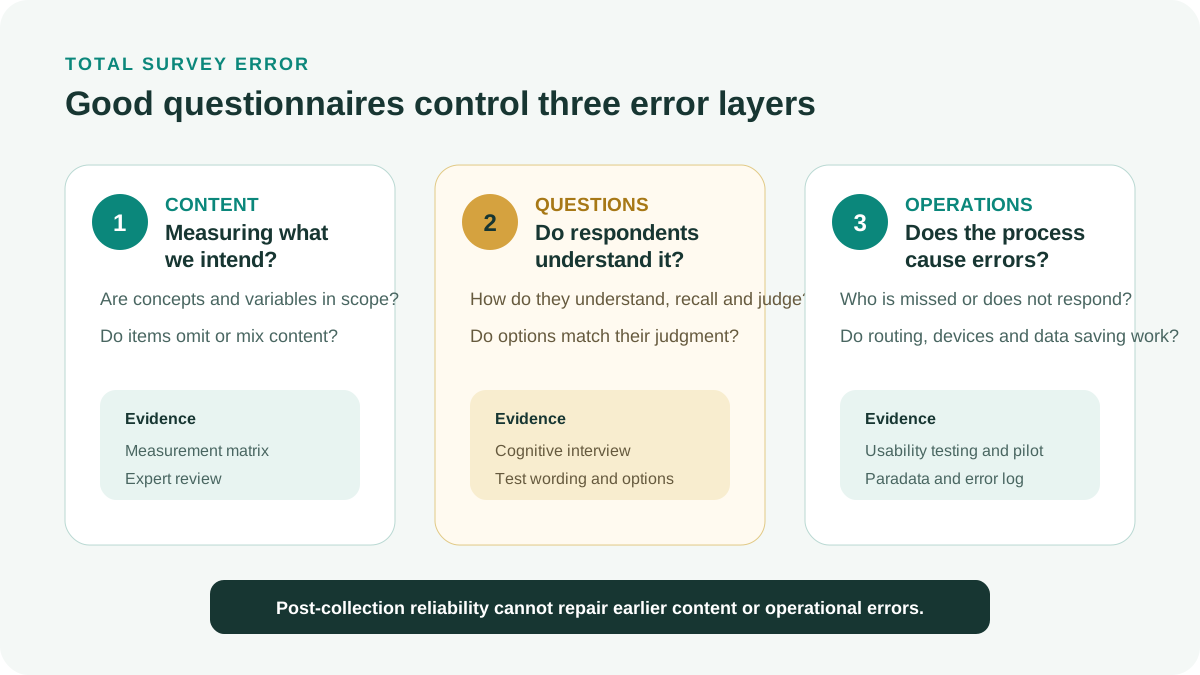
| Layer | Control question | Practical evidence |
|---|---|---|
| Content and specification | Are the right concepts and population being measured? | Measurement matrix, variable definitions, expert review |
| Questions and responses | Do participants understand, remember, and select answers as intended? | Cognitive interviews, wording experiments, paradata |
| Operations and observation | Who is omitted, who does not respond, and does the process cause errors? | Flow diagrams, usability tests, pilots, error and missing-data logs |
Assign every testing finding to an error layer and a revision decision. Do not use post-collection reliability coefficients to conceal pre-existing content or operational errors.
3. Foundation: Turning Objectives into a Measurement Matrix
Every question must serve an analytical decision. If you cannot identify the variable created or the descriptive, screening, control, or hypothesis-testing purpose it serves, the question risks merely lengthening the instrument.
Build the matrix before writing. It reveals two opposing problems: missing important content and repeatedly asking about the same content without a measurement purpose. Dillman et al. (2014) emphasize linking wording with presentation, order, and collection mode because identical content may function differently on paper, telephone, and web.
| Objective | Concept or variable | Role | Data required | Expected output |
|---|---|---|---|---|
| Explain continuance intention | Trust | Predictor | Multiple reflective items | Scale scores and paths |
| Describe the sample | Usage experience | Descriptive or control variable | Years or year categories | Frequencies, medians, or control coefficients |
| Select eligible respondents | Previous service use | Screening question | Yes or no | Condition for continuing |
| Assess quality | Attention or completion time | Process indicator | Paradata or a justified check question | Case review rather than automatic deletion |
Remove sensitive, personally identifying, or directly irrelevant questions. Data minimization reduces both response burden and security risks.
4. Understand the Four Tasks Respondents Must Perform
Participants do not simply retrieve a complete answer and click it. They generally understand the question, retrieve information, form a judgment, and map that judgment onto response options. Problems at any stage generate measurement error (Tourangeau et al., 2000; Peytcheva and Yan, 2025).
When revising, diagnose the difficult stage. Ambiguous terminology concerns comprehension. A 12-month recall period for frequent behavior concerns retrieval. Overlapping answers concern mapping. Sensitive questions may prompt editing during reporting.
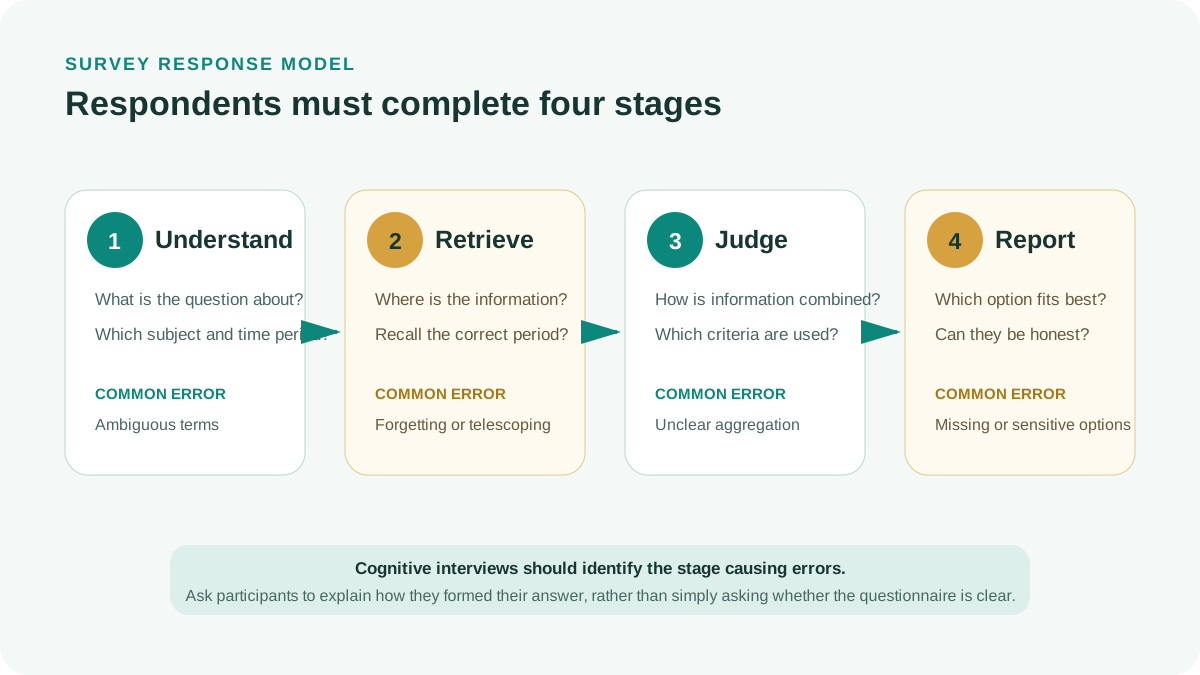
| Stage | Respondent task | Error signs | Remedy |
|---|---|---|---|
| Comprehension | Identify meaning and scope | Asks about terminology or interprets differently from the designer | Use familiar words and necessary reference points and definitions |
| Retrieval | Find events or information in memory | Guessing, forgetting, or confusing timing | Shorten reference periods, add memory cues, and decompose behavior |
| Judgment | Synthesize information into an evaluation | Uncertain how to average or which event to choose | Specify criteria, period, and evaluation target |
| Reporting | Match the judgment to an answer | No suitable answer or only an approximate choice | Complete, nonoverlapping options with clear labels |
5. Choose Question Types According to Information Needs
Behavioral questions ask what happened; attitudinal questions ask evaluations, beliefs, or feelings; demographic questions describe characteristics; knowledge questions assess what respondents know. These four types involve different cognitive burdens and error risks (Peytcheva and Yan, 2025).
Open questions suit unknown response domains or exact numerical answers. Closed questions reduce coding work, but their options may suggest norms and alter answers. Partially closed questions should include Other only when those open responses will actually be read, coded, and used.
| Need | Initial format | Required check |
|---|---|---|
| Frequency with a natural numeric answer | Open numeric field | Units, valid range, reference period |
| One choice from a short list | Radio button | Mutually exclusive options |
| Multiple options may simultaneously apply | Checkbox | Explicitly allow multiple selections |
| Attitudinal construct | Labeled response scale | Endpoints, meaningful intervals, and not-applicable options |
| Screening | Yes/no with skip logic | Test every branch and return route |
| Exploring unknown answers | Short open question | Coding plan before collection |
6. Eight Verifiable Rules for Writing Questions
Good questions are brief without omitting necessary context. Simple vocabulary, direct syntax, and specific targets usually outperform technical language or abstract concepts. Avoid leading questions, judgmental wording, double negatives, and double-barreled questions (Fowler, 2014; Krosnick and Presser, 2010; Peytcheva and Yan, 2025).
Grammar is not the only criterion. A grammatical question can still measure the wrong concept. A stronger check asks target-population members to restate it in their own words and explain their answer choices.
| Error | Example requiring revision | Revision approach |
|---|---|---|
| Ambiguity | Do you study online frequently? | On how many days in the past 7 days did you study online? |
| Double-barreled | The platform is easy to use and trustworthy | Separate ease of use and trustworthiness into two items |
| Leading | Do you agree that this useful system should be maintained? | In your view, should the system be maintained? |
| Negation | You do not oppose making it nonmandatory... | Rewrite as a direct affirmative statement |
| Missing reference period | How many times have you contacted support? | In the past 30 days, how many times have you contacted support? |
| Terminology | Evaluate the system’s interoperability | Use language respondents actually use |
7. Design Response Scales Before Thinking About Cronbach’s Alpha
Response options must cover valid possibilities without overlap. Point counts, numeric labels, presentation direction, and value ranges can affect choices. Do not copy a 1-to-5 scale into every question (Tourangeau et al., 2000).
For attitudes, construct-specific questions about trust, usefulness, or satisfaction are often easier to interpret than repeated agree/disagree statements. Include a midpoint only when neutrality is meaningful. Do not know and Not applicable are different states and should not be combined into the midpoint.
- Every option is meaningful and matches the question.
- Numeric intervals neither overlap nor leave gaps.
- Labels are consistent; label every point where appropriate.
- Do not know, cannot remember, refusal, and not applicable are intentionally handled.
- Scale direction does not change unexpectedly.
- Color is not the sole design cue.
- Small-screen presentation has been checked.
8. Behavioral Questions: Support Recall Rather Than Require Guessing
Salient events are usually easier to remember than repeated behaviors. For frequent behavior over long periods, respondents may use impressions or typical frequencies instead of counting occasions. Response ranges may also signal what is considered normal (Peytcheva and Yan, 2025).
Choose the shortest reference period meeting the objective, use dates or event cues, break broad behavior into memorable situations, and allow enough response time. Consider event-history calendars for long periods. For frequent short-term behavior, diaries may reduce recall burden, although diary keeping itself may alter behavior.
| Problem | Practical design | Remaining risk |
|---|---|---|
| Forgotten events | Short reference periods and personal or public landmarks | Less salient events may still be omitted |
| Combining multiple situations | Decomposition by location, type, or timing | Longer questionnaire |
| Including events outside the period | Explicit starting dates or bounded recall | Telescoping still requires checking |
| Very frequent behavior | Justified typical-frequency questions or diaries | Estimation and monitoring reactivity may occur |
9. Question Order and Survey Flow
Opening questions should be easy, relevant, and reassuringly manageable. Group by topic, move from general to specific, and place sensitive questions later when screening logic permits. Earlier questions can make information salient and alter later responses, so order is part of measurement (Converse and Presser, 1986; Tourangeau et al., 2000; Dillman et al., 2014).
Map every web-questionnaire branch. Ineligible respondents need a polite exit; those selecting Not applicable must not be forced to answer follow-ups; returning to revise an answer must correctly update routing.
Introduction and consent
State purpose, realistic duration, refusal rights, data protection, and contact information.
Screening
Set eligibility conditions and test every exclusion or continuation branch.
Questions serving the main objective
Place important content while respondents remain attentive.
Topic grouping
Keep questions sharing reference frames together while checking context effects.
General to specific
Avoid letting highly specific questions direct general evaluations unless intended.
Sensitive questions
Explain their purpose, use private collection methods, and permit refusal where appropriate.
Necessary demographics
Collect only variables with prespecified analytical, control, or descriptive roles.
Closing
Thank participants, provide support information, and do not promise what the study cannot deliver.
10. A 12-Step Workflow from Draft to Collection-Ready Questionnaire
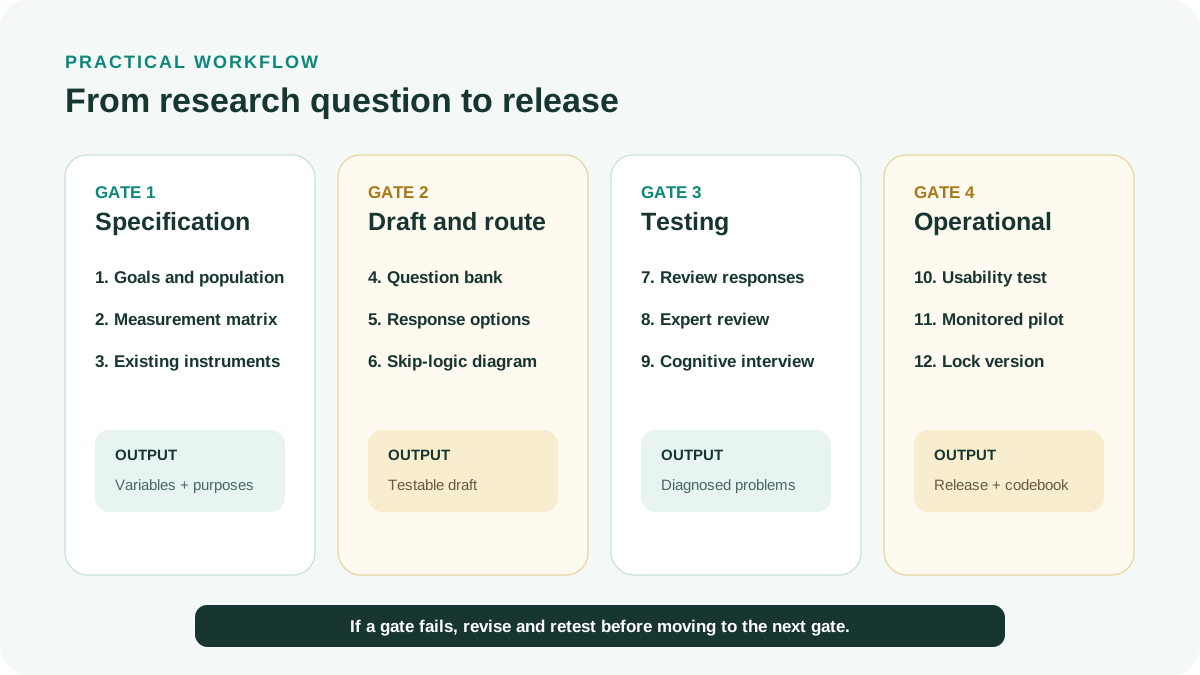
Finalize objectives and population
Write one sentence for each objective, unit of analysis, and eligible participant.
Build the measurement matrix
Connect objectives with concepts, variables, question types, and analytical outputs.
Review existing instruments
Prioritize scales with relevant evidence; check usage rights, language, and context.
Draft a question bank
Write alternatives, each addressing one idea with clear timing and targets.
Design response options
Choose open or closed formats, point counts, labels, exception options, and missing-data rules.
Map the flow
Draw all filters, skips, termination branches, and mandatory conditions.
Self-review using the response model
Diagnose comprehension, retrieval, judgment, and reporting for each question.
Expert review
Ask content and methods experts to assess relevance, omissions, clarity, and risks.
Cognitive interview
Ask target-population participants to think aloud, paraphrase, and explain answer selection.
Usability test
Observe completion on actual devices and modes; record time, errors, returns, and omissions.
Conduct a monitored pilot
Use a small sample under actual procedures; inspect distributions, missingness, duration, branches, and open feedback.
Freeze the version
Save the questionnaire, codebook, logic, revision log, release date, and analysis plan before launch.
If cognitive interviews reveal divergent interpretations, return to question writing. If usability tests reveal operational problems, revise the interface and retest. Proceed to piloting only once content and flow stabilize.
11. What Must Cognitive Interviews and Usability Tests Examine?
Cognitive interviewing goes beyond asking “Does the questionnaire seem fine?” Use specific probes: What does this question ask? Which period did you consider? How did you remember? Why does this option fit better than the adjacent one? Willis (2005) describes this as observing response processes invisible in final data.
Usability testing focuses on tool interaction: recognizing continuation buttons, understanding error messages, completing matrices on phones, returning without data loss, and seeing all labels. Peytcheva and Yan (2025) recommend testing actual usage modes and monitoring effectiveness, efficiency, and satisfaction.
| Question ID | Observed problem | Stage | Severity | Decision | Retest |
|---|---|---|---|---|---|
| Q12 | Three participants interpret “frequently” using three different periods | Comprehension | High | Add a 30-day period | Yes |
| Q18 | Not applicable is invisible on phones | Reporting or interface | High | Change the layout | Yes |
| Q25 | Recalling the number of occasions takes too long | Retrieval | Moderate | Shorten the reference period | Yes |
12. Hypothetical Example: Revising Research-Support Questions
The following example is illustrative rather than actual research data. The initial question asks: “Do you frequently receive prompt and useful support from lecturers?” It has four problems: frequently lacks a time reference; prompt and useful are separate ideas; lecturer is undefined; and people who never requested support have no suitable answer.
The revision uses a filter: “In the past 30 days, have you requested methodological support from your supervisor?” For Yes, separately ask response time in hours/days and usefulness on a labeled scale. For No, skip both evaluations. After cognitive interviews, also verify that all participants understand supervisor as the same role.
| Version | Question | Rationale |
|---|---|---|
| Filter | In the past 30 days, have you requested methodological support from your supervisor? | Identifies people with relevant experience |
| Behavior | On the most recent occasion, how long did a response take? | Specific event, time-based answer |
| Evaluation | How useful was the most recent response for your next analytical step? | One concept, clear target and reference point |
| Exception | I did not receive a response | Does not force this case into a low-usefulness category |
13. Piloting with Stopping Criteria: When Is the Questionnaire Stable Enough?
A pilot should reproduce actual collection: the same devices, invitations, routing, reminders, and storage. Its purpose is to detect remaining errors and estimate operational performance rather than establish stable scale structure from a small sample. Converse and Presser (1986) treat question testing as part of design craftsmanship; Groves et al. (2009) place it within broader error control.
Before piloting, state which errors require revision and retesting. Examples include any skip-logic failure, repeated ambiguous interpretations across participants, missing options for valid cases, unusual concentrated item nonresponse, or completion times exceeding promises. These indicate the main survey should not launch yet.
If piloting produces substantial wording, option, or flow changes, pre- and post-revision data are no longer equivalent. Combine them only with evidence that changes do not affect measurement and when the analysis plan permits.
- Test every branch, including returning to revise answers.
- No errors exclude eligible participants or admit ineligible ones.
- No important questions remain systematically misunderstood.
- Other responses and open feedback do not reveal omitted valid groups.
- Review missingness by item and device.
- Report median duration and interquantile ranges rather than only means.
- Sensitive questions allow refusal without routing failures.
- Record every post-pilot change in a change log and retest.
14. Methods-Reporting Template and Handover Files
Questionnaire-design reports should explain how content was developed and checked. Do not disclose identifiable cognitive-interview narratives, but describe invitees, rounds, probe types, problems identified, and revisions.
Minimum files include the released questionnaire, codebook, skip-logic diagram, measurement matrix, expert-review records, de-identified cognitive-interview logs, usability/pilot results, and change log. These explain every variable in the eventual dataset.
Example report
The questionnaire was developed from [objectives and theoretical framework]. The team linked [number] concepts to analytical variables through a measurement matrix, followed by content review by [expert composition]. The draft underwent [number of rounds] of cognitive interviews with [participant characteristics], focusing on comprehension, retrieval, judgment, and answer selection. Usability testing used [devices or modes]. Major problems included [ ] and were resolved through [ ]. Median pilot duration was [ ], the highest missingness occurred at [ ], and no serious routing errors remained before freezing version [ID, date].
- Each question has a role in the measurement matrix.
- Concepts and reference periods are clear.
- No double-barreled, leading, or confusingly negative questions remain.
- Response options are complete and nonoverlapping.
- Filters and skip logic have been tested on every branch.
- Cognitive interviews use target-population members.
- The web questionnaire has been tested on actual phones.
- Sensitive questions and identifying data have been minimized.
- Pilot revision/stopping criteria are prespecified.
- Save the codebook, version, and change log.
Conclusion
Questionnaire design creates a measurement process. Quality depends on theoretically grounded decisions, testing with intended users, and revision logs before version freezing, rather than an attractive interface or post-collection Cronbach’s alpha.
If you retain one principle, use this: ask participants to demonstrate how they understood, remembered, and selected answers rather than merely asking whether they understood.
References
- Converse, J. M., & Presser, S. (1986). Survey questions: Handcrafting the standardized questionnaire. SAGE Publications.https://doi.org/10.4135/9781412986045
- Dillman, D. A., Smyth, J. D., & Christian, L. M. (2014). Internet, phone, mail, and mixed-mode surveys: The tailored design method (4th ed.). Wiley.https://www.wiley.com/en-us/Internet%2C+Phone%2C+Mail%2C+and+Mixed+Mode+Surveys%3A+The+Tailored+Design+Method%2C+4th+Edition-p-9781118456149
- Fowler, F. J., Jr. (2014). Survey research methods (5th ed.). SAGE Publications.https://us2.sagepub.com/en-us/nam/book/survey-research-methods-4
- Groves, R. M., Fowler, F. J., Jr., Couper, M. P., Lepkowski, J. M., Singer, E., & Tourangeau, R. (2009). Survey methodology (2nd ed.). Wiley.https://www.wiley.com/en-fr/survey-methodology-2nd-edition-p-9781118211342
- Krosnick, J. A., & Presser, S. (2010). Question and questionnaire design. In P. V. Marsden & J. D. Wright (Eds.), Handbook of survey research (2nd ed., pp. 263-313). Emerald Group Publishing.https://web.stanford.edu/dept/communication/faculty/krosnick/docs/2010/2010%20Handbook%20of%20Survey%20Research.pdf
- Peytcheva, E., & Yan, T. (2025). A practical guide to survey questionnaire design and evaluation. Routledge.https://doi.org/10.4324/9781003367826
- Tourangeau, R., Rips, L. J., & Rasinski, K. (2000). The psychology of survey response. Cambridge University Press.https://doi.org/10.1017/CBO9780511819322
- Willis, G. B. (2005). Cognitive interviewing: A tool for improving questionnaire design. SAGE Publications.https://us.sagepub.com/en-us/nam/cognitive-interviewing/book225856
Academic note: Example questions, scales, and values are hypothetical. Questionnaires for clinical, hiring, or diagnostic decisions or vulnerable groups require stronger validation and ethical standards than this introductory guide.