
T-Tests and ANOVA for Higher-Order Construct Scores: Points Requiring Caution
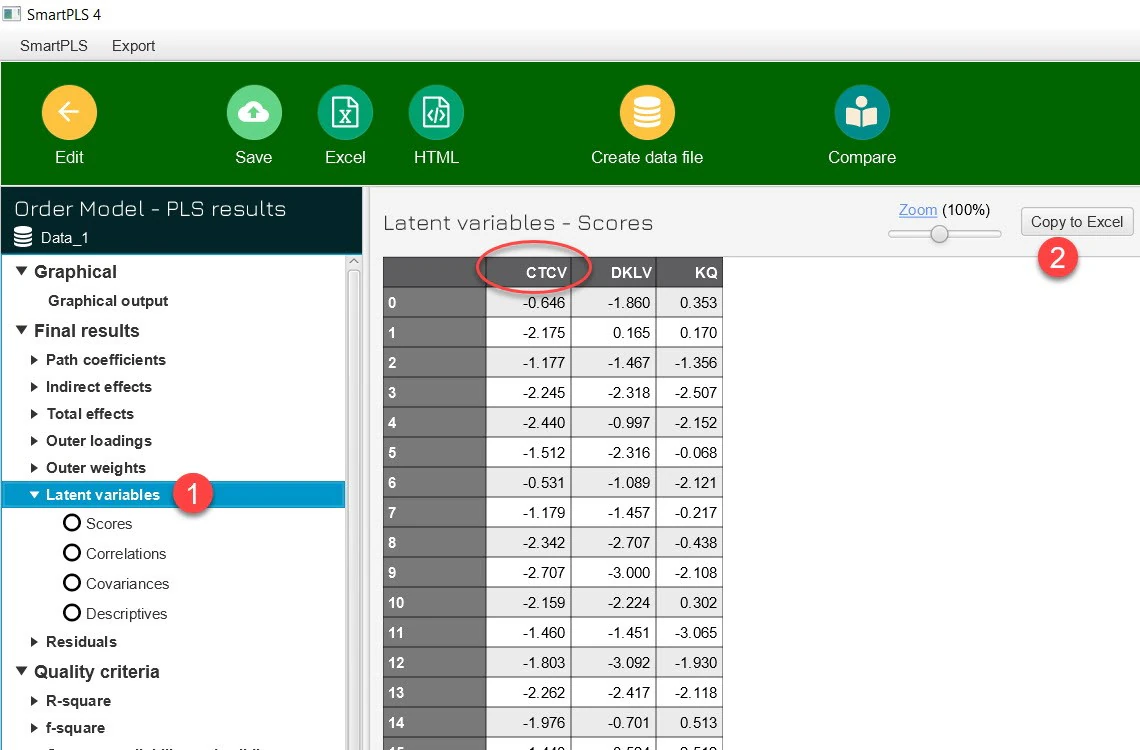
Exporting latent variable scores and running t-tests or ANOVA turns a latent-variable question into a score-based question. This is convenient but does not automatically propagate score-estimation error into group tests.
Before comparing HOC scores across groups, validate the higher-order structure and establish measurement invariance. If using scores, describe how they were generated and treat the analysis as a two-stage approximation; latent mean comparisons in SEM are preferable when rigorous inference is required.
Comparing means: design first, test second
- Design
Independent groups or repeated measures?
- Measurement
Ensure scores are comparable
- Test
Choose for the groups and assumptions
- Reporting
Difference, effect size and CI
Conceptual diagram. Statistical significance does not establish practical importance.
Source: Lê Minh · Conceptual illustration, not software output.1. Two approaches to group comparison
| Approach | Advantages | Limitations |
|---|---|---|
| T-test/ANOVA on scores | Straightforward and intuitive | Treats scores as error-free observations |
| Latent mean comparison/MGA | Models measurement error | Requires invariance and a more complex specification |
2. Establish invariance before comparison
If the same construct has different meanings across groups, score differences may reflect measurement rather than latent levels. CB-SEM usually evaluates configural, metric and scalar invariance; PLS-SEM uses MICOM for appropriate comparison objectives (Putnick & Bornstein, 2016).
Scalar invariance or its relevant counterpart is particularly important for mean comparisons. Checking each group’s alpha is insufficient.
Scores are estimates that depend on the algorithm, standardization and sample. Call them factor/construct scores and retain the export procedure.
3. Two-stage workflow
Validate the HOC
Assess LOCs, the HOC and their measurement relationships first.
Test invariance
Establish whether the structure and measurements are comparable across groups.
Export scores
Use the same algorithm and score metric for all observations.
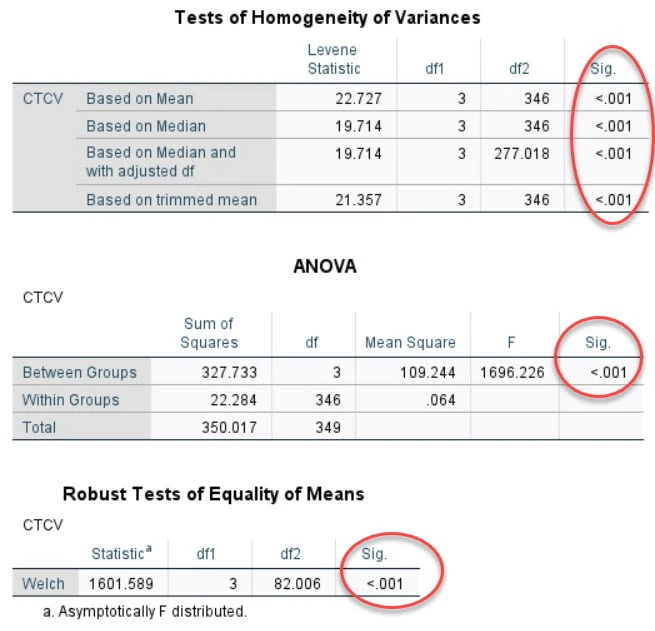
Choose the group test
Use Welch t/ANOVA for unequal variances, and paired/repeated approaches for linked data.
Conduct sensitivity analysis
Compare score-based conclusions with MGA or a latent mean model when possible.
4. Adjust for multiple testing
Testing multiple LOCs, HOCs and groups rapidly increases the number of tests. Define the primary outcome, address multiplicity or clearly distinguish confirmatory from exploratory analyses.
Report effect sizes and CIs for priority differences; mean plots should display uncertainty rather than bare bars.
| Layer | Content |
|---|---|
| Measurement | Valid HOC and invariance |
| Scores | Generation, standardization and range |
| Testing | Welch/ANOVA/post hoc tests and multiplicity |
| Magnitude | Mean difference, CI, effect size |
| Sensitivity | MGA/latent means where available |
5. Reporting template
Reporting example in English
The higher-order construct [ ] was estimated using [method]; invariance was established at [level]. Construct scores were exported using [ ] and compared between [groups] with [Welch t/ANOVA]. The mean difference was [ ], 95% CI [ ; ], effect size [ ]. Results were treated as [a two-stage approximation/confirmed by a latent mean model].
- Assess the HOC before comparing groups.
- Test invariance.
- Describe score generation.
- Use robust tests when required.
- Adjust for multiple comparisons.
- Do not describe a score as a directly observed latent variable.
Conclusion
Higher-order construct comparisons are trustworthy only when groups share a comparable measure. T-tests and ANOVA on scores can be useful, but should be identified as two-stage analyses.
References
- Putnick, D. L., & Bornstein, M. H. (2016). Measurement invariance conventions and reporting. Developmental Review, 41, 71–90.https://doi.org/10.1016/j.dr.2016.06.004
Methodological note: If the primary objective is latent mean comparison, prioritize a multigroup model with invariance rather than exporting scores and ignoring measurement error.