
SERVQUAL and SERVPERF: choose service-quality measurement and validate its use
A questionnaire labeled SERVQUAL or SERVPERF is not automatically appropriate for a hospital, bank or digital service. Define the quality construct, explain any expectation standard, and ensure scoring preserves respondent-level information.
SERVQUAL examines perceptions relative to expectations, while SERVPERF focuses on perceived performance. Select an approach through the research question, respondent burden and measurement evidence in the intended setting.
SERVQUAL and SERVPERF: two measurement questions
- Expectations
What customers expect
- Perceptions
The experience customers evaluate
- Gap
Consider measuring the gap
- Performance
Consider perception-based measurement
Conceptual diagram. Choose measurement for the service-quality concept and context.
Source: Lê Minh · Conceptual illustration, not software output.1. Separate quality from satisfaction
Perceived quality may concern process reliability or a broader service evaluation. Satisfaction also depends on the encounter and comparison standards. Define these constructs separately (Wirtz & Lovelock, 2022).
A customer may recognize technically competent service while remaining dissatisfied with price or waiting time. Renaming satisfaction statements as quality items does not establish content validity. Specify the organization, service encounter and reference period.
2. Understand the two measurement approaches
The original SERVQUAL instrument has 22 attributes evaluated through expectations and perceptions, commonly associated with tangibles, reliability, responsiveness, assurance and empathy (Parasuraman et al., 1988). Using both sets for all 22 attributes entails 44 ratings; adaptations need not have that count.
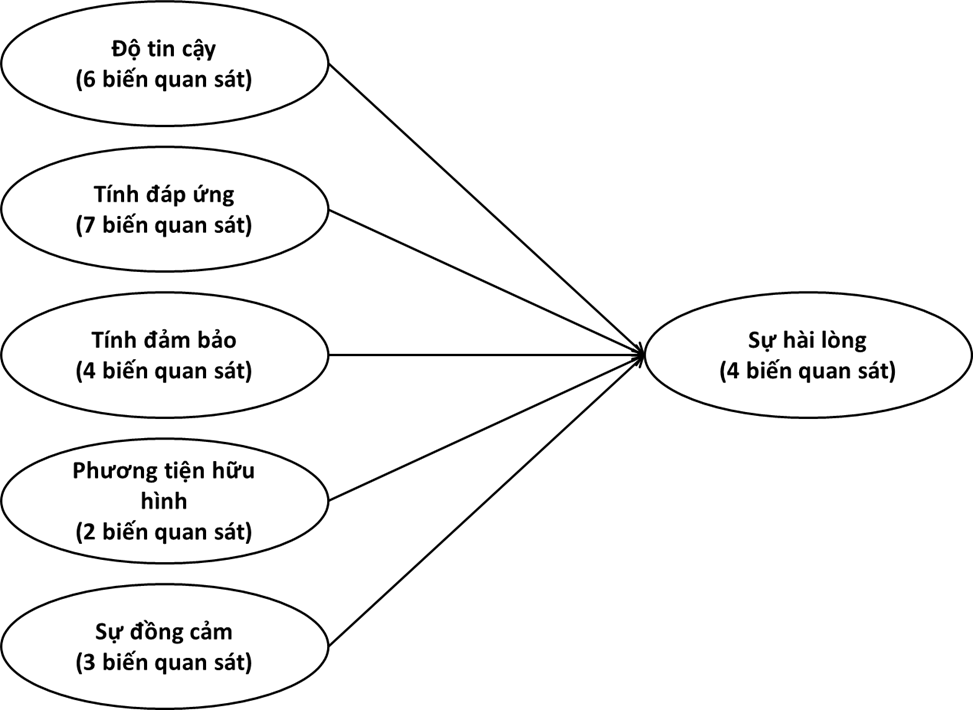
SERVPERF proposes a performance-based alternative (Cronin & Taylor, 1992). Removing an expectation round can reduce repetition, but does not establish universal superiority or preserve a factor structure automatically after translation.
| Decision | SERVQUAL | SERVPERF |
|---|---|---|
| Main information | Perceptions relative to defined expectations | Perceived performance |
| Clarification | Desired, predicted or another expectation standard? | Which organization, encounter or time period? |
| Risks to examine | Mismatched E/P pairs, burden and ambiguous standards | Missing content and confusion with satisfaction |
| Evidence still needed | Content and measurement structure | Content and measurement structure |
3. Identical gaps can hide different experiences
In a hypothetical 1–7 example, customer A has E = 6 and P = 5, while customer B has E = 4 and P = 3. Both gaps are −1 despite different performance ratings. Retain and examine the components rather than ranking gaps alone.
SERVQUAL difference rule: Gᵢⱼ = Pᵢⱼ − Eᵢⱼ, for the same person i and attribute j (Parasuraman et al., 1988).
A negative gap does not identify an operational cause. Service problems, expectation management or inconsistent reference periods require investigation. A difference score’s properties depend on its components and their relationship; neither universal reliability nor universal invalidity should be assumed.
4. Preserve pairs when handling missingness
Suppose three customers have E = (6, 5, 4) and P = (5, 4, missing). The two complete-pair gaps both equal −1. Subtracting mean E = 5 across three people from mean P = 4.5 across two gives −0.5 because the denominators involve different people. This is an aggregation error.
Declare the minimum valid pairs for person-level scoring and treatment of incomplete dimensions. Retain E, P and gaps. Complete-case selection still needs an assessment of missingness and sample changes.
| Record | Purpose |
|---|---|
| Respondent and attribute identifiers | Match E/P correctly |
| Valid pair count | Expose each denominator |
| Coding direction and anchors | Avoid incompatible subtraction |
| Missing-data rule | Explain sample changes and limitations |
5. Adapt content before testing structure
Published measures require attention to construct coverage and wording. Translation, cognitive interviews and piloting help check how questions are understood (DeVellis & Thorpe, 2022). A physical-facilities item may need a documented adaptation for an entirely digital service.
Do not delete items merely to recover five groups or increase alpha. This can narrow content coverage. Distinguish exploring a structure from testing a justified structure, and acknowledge when modifications depend on the same sample.
Reliability assessment belongs alongside structural and validity evidence. Group or time comparisons require measurement equivalence appropriate to the intended inference (Kline, 2023). A higher score may reflect a different interpretation of the items.
6. A workflow and reporting template
- Define quality, satisfaction and outcomes separately.
- Justify the approach and any expectation standard.
- Document original items, translation, changes and permissions.
- Pilot understanding, burden and E/P pairing.
- Plan structure, reliability and validity assessment.
- Declare scoring, missingness and group comparisons.
- Report unfavorable findings and post-analysis changes.
Measuring both sides is useful when the question concerns a clearly defined expectation–experience gap. Performance measurement may suit monitoring perceived delivery and its associations with outcomes. Both choices still need evidence for the intended context.
Reporting template
The study used [SERVQUAL/SERVPERF/adaptation] to measure [definition]. Items were adapted through [process]. Scores followed [formula] with [minimum items/pairs] and [missing-data rule]. Structure [ ] and measurement evidence [ ] support use within [scope], subject to [limitations].
References
- Cronin, J. J., Jr., & Taylor, S. A. (1992). Measuring service quality: A reexamination and extension. Journal of Marketing, 56(3), 55–68. https://doi.org/10.1177/002224299205600304
- DeVellis, R. F., & Thorpe, C. T. (2022). Scale development: Theory and applications (5th ed.). SAGE https://au.sagepub.com/en-gb/anz/scale-development/book269114
- Kline, R. B. (2023). Principles and practice of structural equation modeling (5th ed.). The Guilford Press https://www.guilford.com/books/Principles-and-Practice-of-Structural-Equation-Modeling/Rex-Kline/9781462551910
- Parasuraman, A., Zeithaml, V. A., & Berry, L. L. (1988). SERVQUAL: A multiple-item scale for measuring consumer perceptions of service quality. Journal of Retailing, 64(1), 12–40. https://www.researchgate.net/publication/200827786_SERVQUAL_A_Multiple-item_Scale_for_Measuring_Consumer_Perceptions_of_Service_Quality
- Wirtz, J., & Lovelock, C. (2022). Services marketing: People, technology, strategy (9th ed.). World Scientific https://doi.org/10.1142/Y0024