
Higher-Order PLS-SEM Models in SmartPLS 4: Specification, Two-Stage Estimation, and Reporting
Do not create a higher-order model merely because lower-order constructs are correlated. Establish the relationship between the higher-order construct and its component dimensions theoretically before choosing an estimation approach.
A defensible workflow involves four decisions: identify the roles of HOCs and LOCs, classify reflective or formative relationships at each level, select an appropriate estimation method, and assess the measurement model separately at both stages. The disjoint two-stage approach separates the levels and documents all decisions for reproducibility.
From lower-order components to a higher-order construct
- Theory
Define the role of each component
- Measurement
Assess lower-order constructs
- Higher order
Specify relationship directions
- Verification
Assess and report each stage
Conceptual diagram. Reflective or formative directions need conceptual justification.
Source: Lê Minh · Conceptual illustration, not software output.1. What Should You Be Able to Do After This Article?
After this guide, readers should be able to identify HOCs and LOCs, classify the four types of higher-order models, create two model files for the disjoint two-stage approach, assess the LOC and HOC levels using the correct criteria, and write a verifiable results paragraph. The workflow uses SmartPLS 4; reports should therefore identify the software version and cite its developers (Ringle et al., 2024).
Minimum inputs include a theoretical model, definitions of each construct, a construct-to-indicator mapping, cleaned data, and reflective or formative decisions for each level. If you cannot explain why the LOCs are manifestations or components of the HOC, do not yet create the model in SmartPLS.
- Provide conceptual definitions for the HOC and each LOC.
- Provide theoretical literature supporting the dimensions’ membership in the same construct.
- Determine the direction of the HOC–LOC relationship.
- Classify each LOC’s measurement model.
- Check the data for missing values, coding, and response quality.
- Clearly identify the variables included in the nomological network at each stage.
2. HOCs and LOCs: Different Levels of Abstraction
A higher-order construct (HOC) represents a more abstract concept, while lower-order constructs (LOCs) represent its specific dimensions. Higher-order constructs may simplify a model, but their principal purpose is to represent the concept’s multidimensional nature accurately (Becker et al., 2012; Sarstedt et al., 2019).
High correlations among LOCs do not justify an HOC by themselves. Researchers must explain the shared content domain, boundaries between dimensions, and linking mechanism. Two LOCs with similar content that do not belong to the same higher-order concept may produce an easily estimated but theoretically incorrect model.
If the HOC changes, are the LOCs expected to change together as partially interchangeable manifestations? If so, the HOC-to-LOC relationship follows reflective logic. If each LOC contributes distinct content and removing one changes the HOC’s meaning, the LOC-to-HOC relationship follows formative logic.
3. Four Types of Higher-Order Models
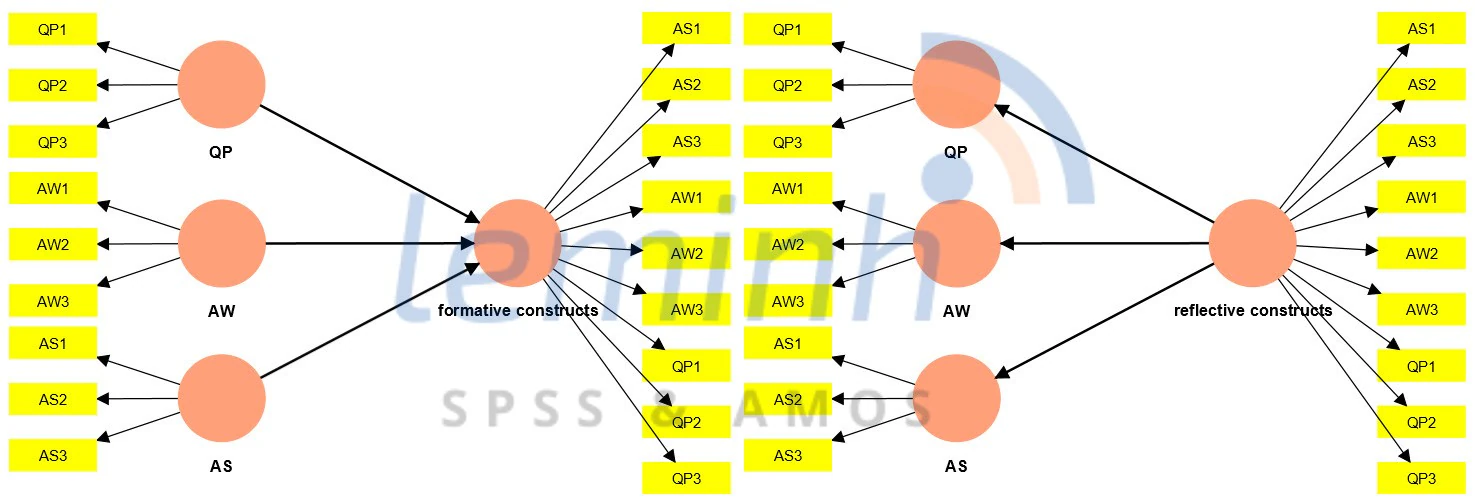
Model names combine two decisions: how indicators measure LOCs and how the HOC relates to LOCs. The convention below follows SmartPLS (n.d.) and Sarstedt et al. (2019). In reports, describe both levels rather than simply writing Type I, II, III, or IV, because naming order can differ across sources.
| Type | Indicators and LOCs | HOC–LOC relationship | Assessment at the HOC level |
|---|---|---|---|
| Reflective-reflective | LOCs reflected by indicators | HOC explains variation in LOCs | Loadings, reliability, convergent and discriminant validity |
| Formative-reflective | LOCs formed by indicators | HOC explains variation in LOCs | LOC loadings on the HOC; assess weights and VIF at the LOC level |
| Reflective-formative | LOCs reflected by indicators | LOCs form the HOC | Outer weights, VIF, and substantive meaning |
| Formative-formative | LOCs formed by indicators | LOCs form the HOC | Weights and VIF at both levels |
4. Choosing Repeated Indicators or Two-Stage Estimation
The repeated-indicators approach assigns all LOC indicators to the HOC. This is intuitive, but LOCs with more indicators may dominate the HOC, and HOC-level assessment can become entangled with LOC-level assessment. Becker et al. (2012) show that the estimation method should suit the HCM type and the HOC’s position in the model.
The disjoint two-stage approach uses only LOCs in stage one to generate construct scores, then uses these scores as HOC indicators in stage two. Sarstedt et al. (2019) recommend this approach because it clearly separates the levels and applies more broadly across HOC types.
| Situation | Option to consider | Reason |
|---|---|---|
| Large differences in indicator counts across LOCs | Disjoint two-stage | Reduces the risk of LOCs with more indicators dominating the HOC |
| Formative HOC | Two-stage or extended repeated indicators | Requires assessment of weights, VIF, and LOC content |
| Large model or multiple HOCs | Disjoint two-stage | Separates models, reduces complexity, and facilitates checking |
| Initial illustration with balanced reflective–reflective measurement | Repeated indicators may be used | Quick setup, but sensitivity must still be assessed |
5. Stage One: Estimating and Validating LOCs
In the disjoint two-stage approach, stage one does not include the HOC. LOCs are connected to other constructs according to the nomological network to generate meaningful scores and avoid a completely isolated measurement model. SmartPLS (n.d.) illustrates this logic using a corporate reputation model.
Assess LOCs according to their measurement-model types. Reflective LOCs require loadings, reliability, AVE, and discriminant validity. Formative LOCs require collinearity assessment, outer weights, confidence intervals, and examination of the loading’s absolute contribution when the weight is nonsignificant.
Create the Stage 1 model
Include only LOCs with their original indicators and the necessary relationships in the nomological network. Do not include the HOC in this model.
Run the PLS-SEM Algorithm
Record the weighting scheme, stopping criterion, number of iterations, and other settings for consistent use.
Assess each LOC
Use the appropriate reflective or formative criteria; do not substitute criteria from one level for those of the other.
Make justified model modifications
Modify only when measurement or data considerations justify doing so. Document every removed indicator and its effect on the content domain.
Run bootstrapping
Check the confidence intervals of loadings or weights and other required parameters before accepting Stage 1.
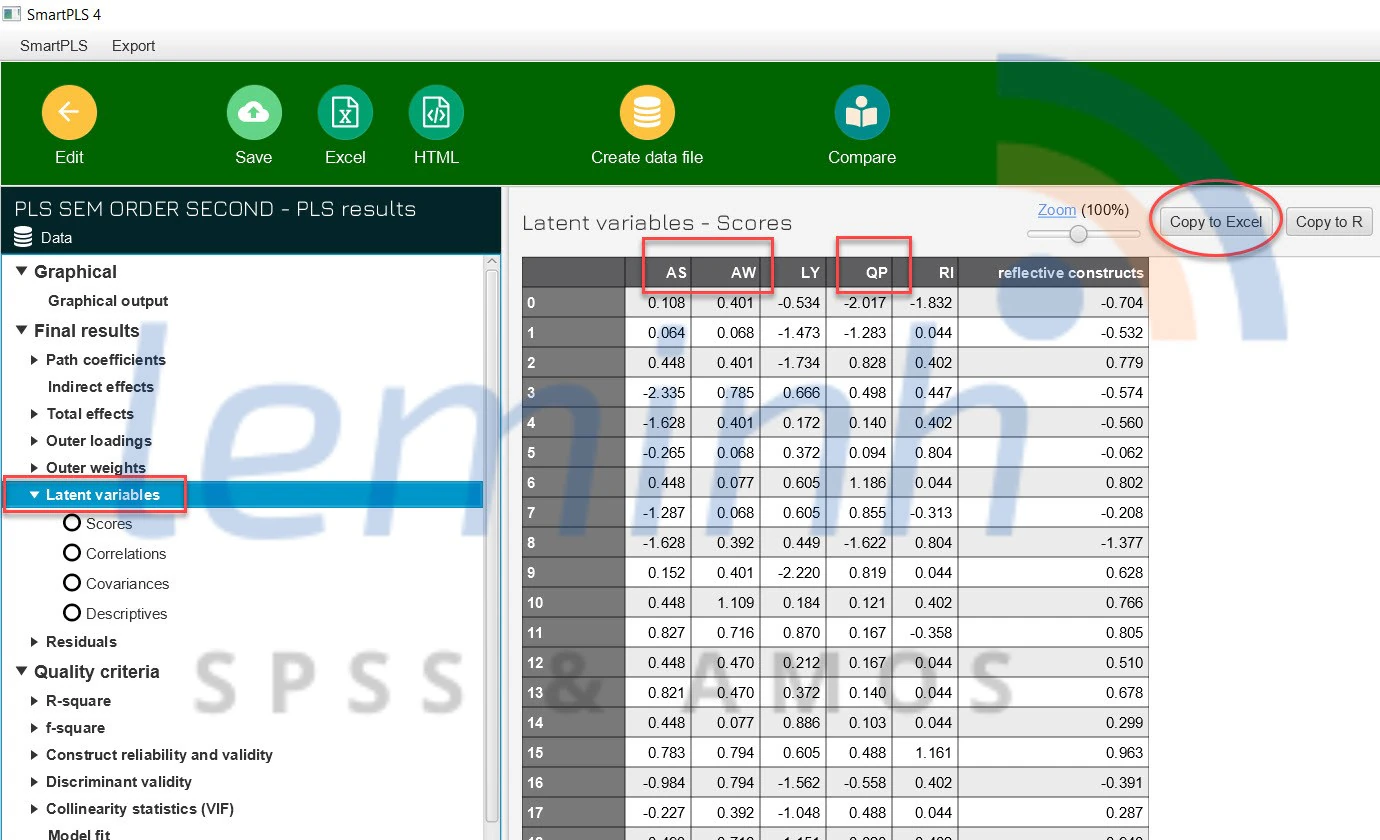
Export construct scores
Save scores for the LOCs that meet the requirements, together with observation IDs to prevent incorrect row matching.
6. Stage Two: Creating and Assessing the HOC
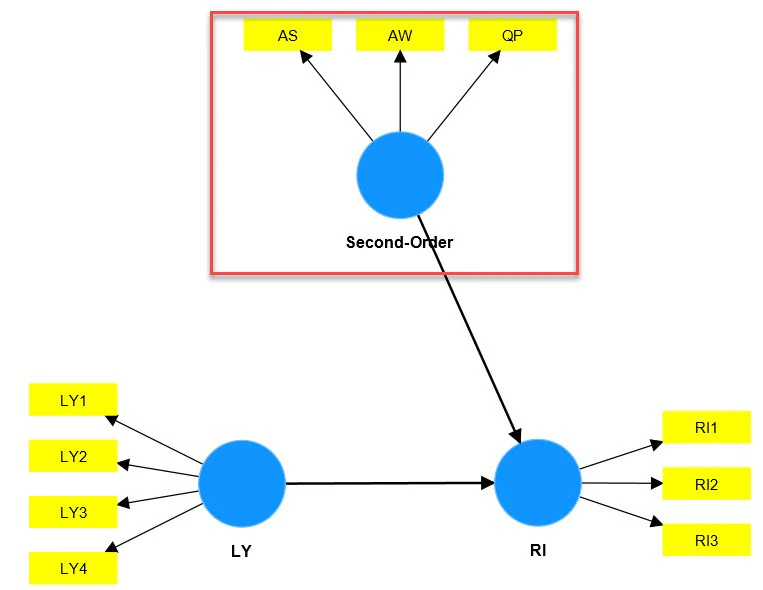
Stage two uses LOC scores as indicators of the HOC. Match score columns to the correct observations in the original data. If row order changes or identifiers are unavailable for checking, the model may still run, but its results are no longer valid.
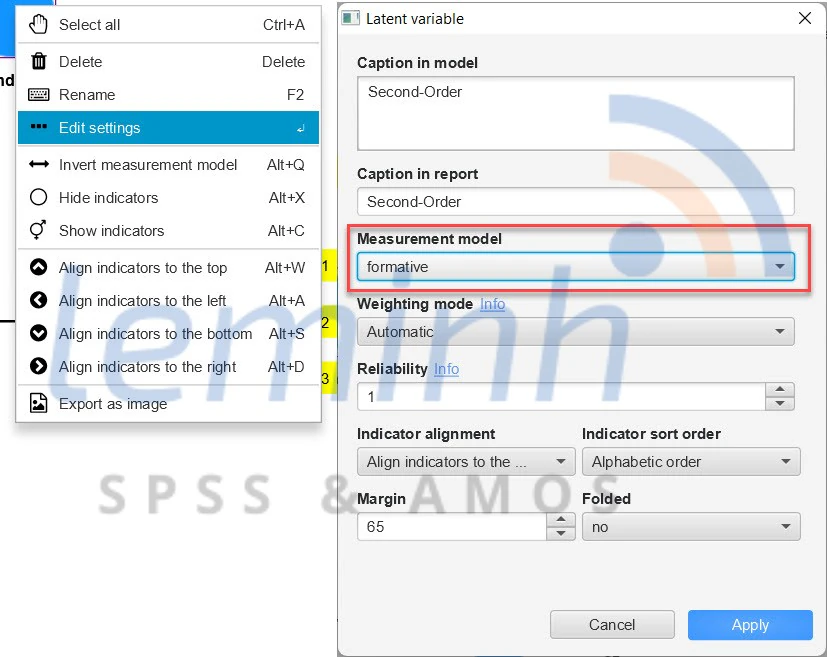
Assess the relationship between the HOC and scores as a measurement model. For a reflective HOC, scores serve as reflective indicators; for a formative HOC, they are components forming the HOC. Interpret these relationships as loadings or weights rather than ordinary structural hypotheses.
Create the Stage 2 dataset
Merge LOC scores with the variables to be retained. Compare row counts, observation IDs, and missing data before importing.
Import the new dataset
Use a name containing a version and creation date, and explicitly record the source of scores for reproducibility.
Create the HOC
Assign each LOC score as an HOC indicator and select reflective or formative measurement according to the theoretical decision.
Complete the structural model
Replace LOCs with the HOC in relationships that theory actually specifies at the higher-order conceptual level.
Run the algorithm and bootstrap
Use the same core settings, enough bootstrap samples for stable confidence intervals, and save the seed when the software permits.
Assess the HOC and structural model
Check the HOC’s measurement model before interpreting paths, R², f², or prediction.
7. Interpreting Output According to HOC Type
For a reflective HOC, LOC-score loadings should be sufficiently strong and have suitable confidence intervals. Reliability and AVE are used as in a reflective measurement model, but HOCs often have few indicators, so decisions cannot rely on a mechanical threshold alone.
For a formative HOC, check VIF among LOC scores, then interpret outer weights and their confidence intervals. A nonsignificant weight does not automatically justify removing an LOC. If its absolute loading and substantive validity remain important, removing that dimension may change the HOC’s definition (Sarstedt et al., 2019).
| HOC type | Main output | Practice to avoid |
|---|---|---|
| Reflective | Loadings, CI, rho_A or CR, AVE, and discriminant validity against other constructs | Using VIF and weights as the principal decision criteria |
| Formative | VIF, outer weights and CI, supplementary outer loadings, and content validity | Removing an LOC solely because its weight has a large p-value |
| Both | Stability of paths, R², f², and prediction where appropriate | Interpreting HOC–LOC relationships as independent structural hypotheses |
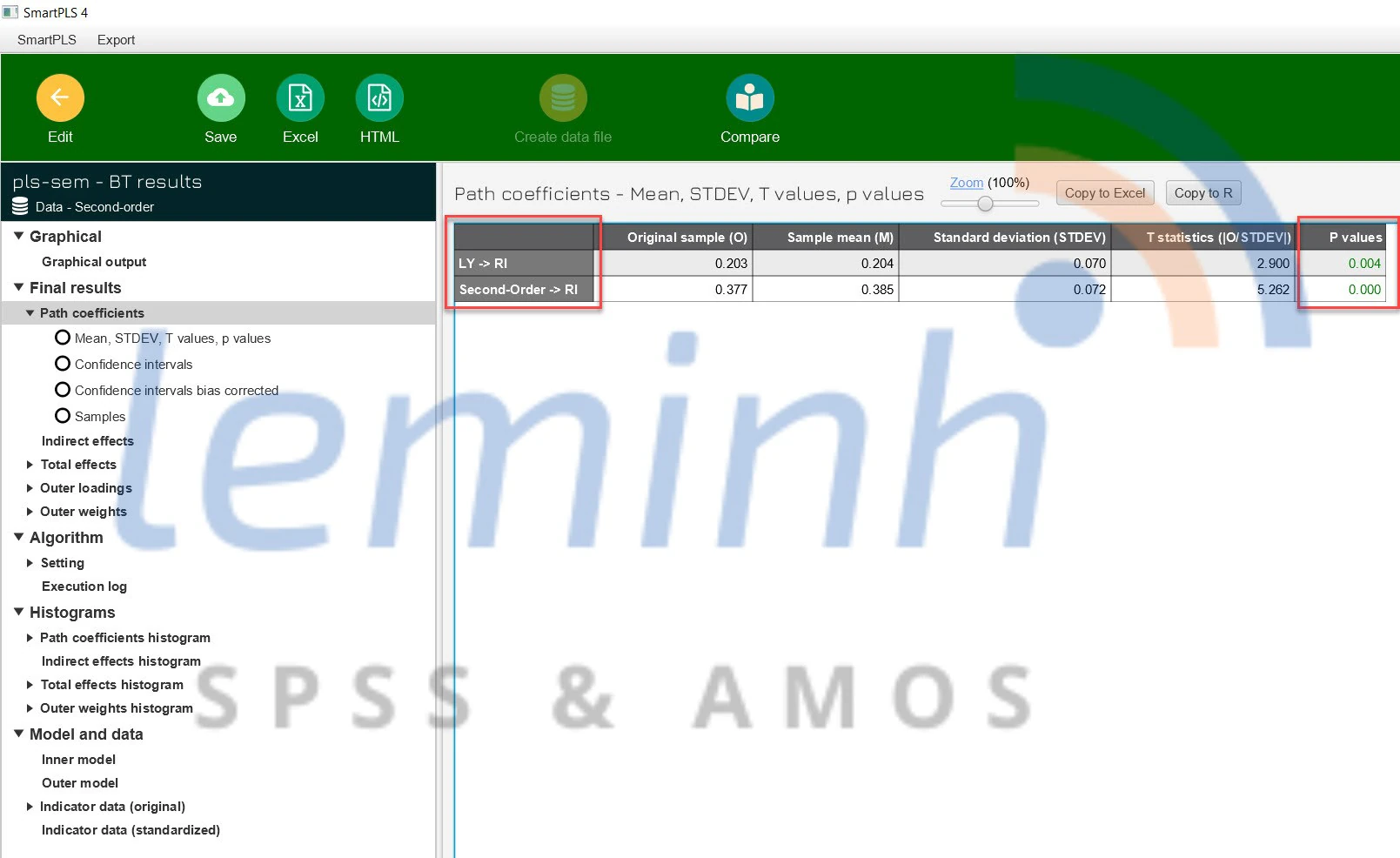
8. Hypothetical Numerical Example: Digital Service Quality
The example below is illustrative rather than client data. Suppose Digital Service Quality is a reflective–reflective HOC comprising Reliability, Transparency, and Responsiveness. Stage 1 indicates that all three LOCs meet the planned reliability, AVE, and discriminant validity requirements.
At Stage 2, the three LOC-score loadings on the HOC are 0,84; 0,79; and 0,72. Their hypothetical 95% bootstrap confidence intervals are [0,78; 0,89], [0,71; 0,85], and [0,63; 0,80], respectively. HOC composite reliability is 0,83 and AVE is 0,62. These values illustrate interpretation rather than universal guarantees for every study.
| LOC score | Loading | 95% CI | Illustrative decision |
|---|---|---|---|
| Reliability | 0,84 | [0,78; 0,89] | Retain |
| Transparency | 0,79 | [0,71; 0,85] | Retain |
| Responsiveness | 0,72 | [0,63; 0,80] | Retain |
The example’s loadings, CR, and AVE were created to practice interpretation. Actual conclusions must rely on the study’s data, design, number of dimensions, scale quality, and confidence intervals.
9. Errors That Make Higher-Order Models Difficult to Defend
| Error | Consequence | Remedy |
|---|---|---|
| Creating an HOC because LOCs are highly correlated | The higher-order relationship lacks substantive justification | Start with definitions and the conceptual domain |
| Calling every HOC reflective–reflective | Incorrect use of loadings, weights, and assessment criteria | Determine relationship directions at both levels |
| Assessing only Stage 2 | It remains unknown whether LOC measurement is adequate | Report Stage 1 results separately |
| Merging scores in the wrong row order | Estimates are meaningless even though the software runs | Use observation IDs and randomly check multiple rows |
| Removing a formative LOC because its p-value is large | The HOC’s content domain is lost | Consider weights, loadings, VIF, and theory together |
| Using the same model for both stages | LOC and HOC roles become confused | Save two models, two datasets, and a decision log |
10. APA 7 Reporting Template and Completion Checklist
Example report
[HOC name] was specified as a [reflective/formative] higher-order construct comprising [list of LOCs], based on [theoretical rationale]. The study used the disjoint two-stage approach in SmartPLS 4 (Ringle et al., 2024). At Stage 1, LOCs were assessed using [criteria] and [met/did not meet] the requirements. LOC scores were merged by observation ID and used as HOC indicators at Stage 2. The [loadings/weights] ranged from [min; max], with bootstrap CIs [description]. HOC-level results indicated [CR, AVE, or VIF], supporting [conditional conclusion].
- State the theoretical rationale for the HOC and each LOC.
- Describe the measurement-model type at both levels.
- Specify whether repeated indicators or two-stage estimation was used.
- Report the Stage 1 criteria and results.
- Describe how construct scores were exported, merged, and checked.
- Assess Stage 2 using the correct loadings or weights.
- Run bootstrapping and report confidence intervals.
- Separate measurement results from structural results.
- Save both models, both datasets, and the software settings.
Conclusion
A higher-order model is appropriate when theory requires both an overarching concept and specific dimensions. Its value comes from accurately representing the conceptual structure rather than simply reducing the number of paths.
The disjoint two-stage approach provides a verifiable workflow: validate LOCs, export scores under controlled conditions, specify the HOC, then assess the Stage 2 measurement and structural models. If one level is overlooked, attractive results cannot compensate for a gap in the measurement argument.
References
- Becker, J.-M., Klein, K., & Wetzels, M. (2012). Hierarchical latent variable models in PLS-SEM: Guidelines for using reflective-formative type models. Long Range Planning, 45(5-6), 359-394.https://doi.org/10.1016/j.lrp.2012.10.001
- Sarstedt, M., Hair, J. F., Cheah, J.-H., Becker, J.-M., & Ringle, C. M. (2019). How to specify, estimate, and validate higher-order constructs in PLS-SEM. Australasian Marketing Journal, 27(3), 197-211.https://doi.org/10.1016/j.ausmj.2019.05.003
- Ringle, C. M., Wende, S., & Becker, J.-M. (2024). SmartPLS 4 [Computer software]. SmartPLS.https://www.smartpls.com
- SmartPLS. (n.d.). Higher-order models.https://www.smartpls.com/documentation/algorithms-and-techniques/extended-relationships/higher-order/
Academic note: The example values illustrate how to interpret output. HOC, LOC, and estimation-method choices must follow theory, measurement-model type, and the specific study design.