
Missing GFI in AMOS: check mean structure and diagnose the right issue
A missing GFI entry does not establish estimation failure. Check configuration first and distinguish an unreported index from an inadmissible or nonconverged solution.
The official AMOS FAQ says GFI, PGFI, AGFI and RMR are not reported when means and intercepts are estimated. Do not remove a needed mean structure merely to obtain an index.
Diagnose the model instead of chasing one index
- Specification
Check the model and identification
- Estimation
Inspect convergence and admissibility
- Model fit
Read several indices and residuals
- Reporting
State available indices and limitations
Conceptual diagram. A missing GFI is not a reason to alter a model merely to obtain it.
Source: Lê Minh · Conceptual illustration, not software output.1. First inspect means and intercepts estimation
AMOS documents this omission for means/intercepts estimation (Amos Development Corporation, n.d.-a). It can be expected reporting behavior under that configuration rather than evidence of nonconvergence.
Inspect View → Analysis Properties → Estimation → Estimate means and intercepts. Record its state, the AMOS version, estimator and analyzed data. Menu wording can vary; consult the installed release guidance.
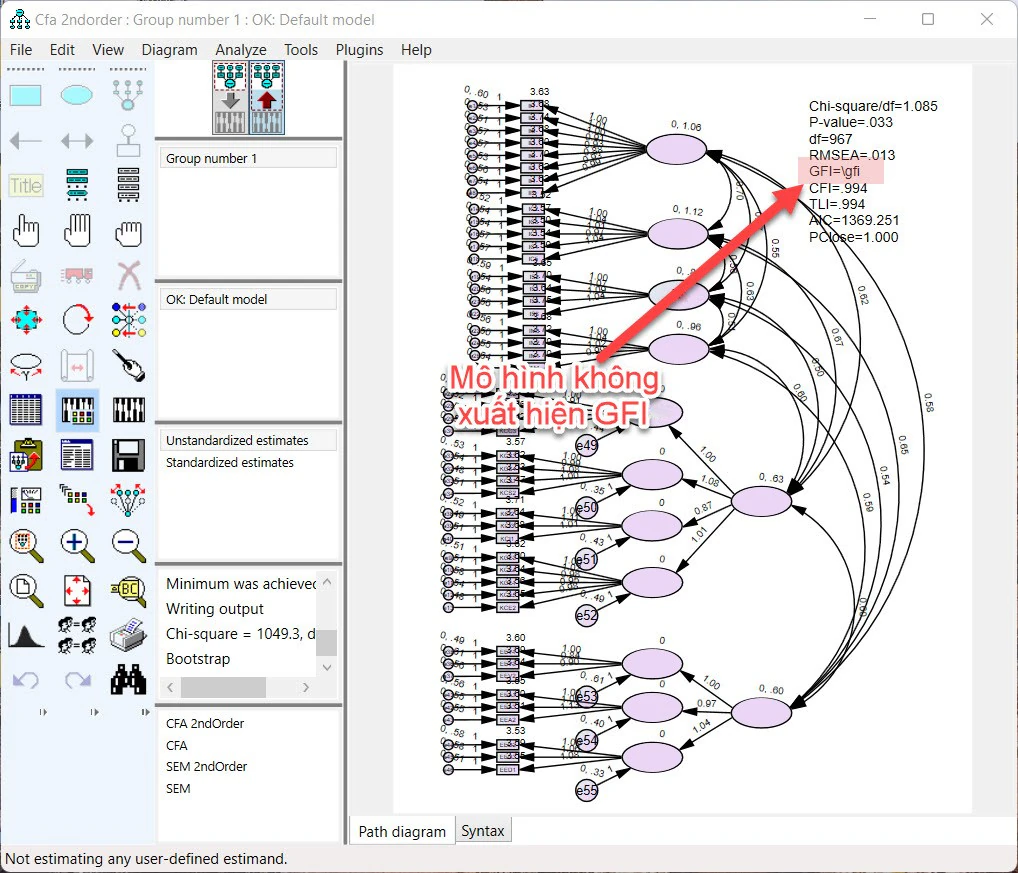
The original image helps identify the output under discussion. An absent row in a screenshot cannot diagnose every AMOS file; configuration and messages are needed.
2. Should the option be disabled?
Change the option only when consistent with the research question and specification. Means/intercepts matter for mean structures, and missing-data handling depends on the AMOS implementation (Arbuckle, 2020). Removing a necessary option changes the estimation problem.
For a covariance-only model with complete data, reconsider whether a mean structure is needed. If examining latent means or intercepts, or using missing-data procedures requiring that configuration, retain the appropriate specification and explain the omission.
Do not replace a blank with zero, label a separately calculated value as AMOS output, or switch procedures solely to fill an old reporting template.
3. Inspect reference models with incomplete data
Some fit measures depend on saturated and independence reference models. Official AMOS help documents their estimation options with incomplete data (Amos Development Corporation, n.d.-b). A solution for the substantive model does not guarantee successful reference-model estimation.
An unavailable independence-model fit can prevent CFI calculation; failure to estimate the saturated model can prevent the χ² statistic that needs that comparison (Arbuckle, 2020). Read the exact messages rather than confusing this with GFI omission under mean estimation.
Record missingness patterns, inspect constant or duplicate columns and covariance information, and read each model’s warnings. More output after enabling options is not proof that missingness was handled appropriately. Report any changed sample or specification.
4. Evaluate the solution before fit
Even a complete fit table can accompany identification problems, negative variances or unusual standard errors. Examine messages, estimates and residuals together (Kline, 2023). A just-identified model with df = 0 does not offer the same structural test as a model with testable restrictions.
| Situation | Inspect | Response |
|---|---|---|
| Converged; no GFI; means/intercepts estimated | Settings and version-specific FAQ | Retain the needed specification and explain omission |
| No CFI or χ² with incomplete data | Reference models and their messages | Diagnose the relevant comparison model |
| Fit available but negative variance or unusual SE | Data, identification and specification | Investigate admissibility before drawing conclusions |
5. Do not relabel RMR as SRMR
Raw-scale RMR and standardized SRMR are different quantities (Kline, 2023). Preserve the output label and establish how the statistic was calculated before applying an interpretation rule.
Use available evidence appropriate to the estimator and model: defined tests, approximate fit, residuals and parameter diagnostics. One cutoff cannot certify an entire model, measurement quality or causal interpretation.
6. Keep a diagnostic record and report transparently
- Archive version, estimator and means/intercepts settings.
- Document analyzed cases and missing-data handling.
- Read substantive and reference-model messages.
- Inspect identification, variances, SEs and residuals.
- Match index names to output, especially RMR/SRMR.
- Do not interpret a blank as zero or automatic failure.
Reporting template when retaining mean structure
The model used [estimator] in AMOS [version], estimating means and intercepts because [reason]. GFI/AGFI/PGFI/RMR were not reported under this configuration. Evaluation used [available indices], [residuals] and [solution diagnostics]. Missingness was handled through [ ], with reference-model status [ ].
Continue: SEM selection and evaluation evidence. For troubleshooting, provide settings, messages and relevant output after removing personal information.
References
- Amos Development Corporation (n.d.-a). Why didn't Amos report GFI, PGFI, AGFI and RMR?. https://amosdevelopment.com/support/faq/no_gfi.htm
- Amos Development Corporation (n.d.-b). For the purpose of computing fit measures with incomplete data. https://amosdevelopment.com/webhelp/forthepurposeofcomputingfitmeasureswithincompletedata1.html
- Arbuckle, J. L. (2020). IBM SPSS Amos 27 user's guide. IBM https://public.dhe.ibm.com/software/analytics/spss/documentation/statistics/27.0/en/amos/Manuals/IBM_SPSS_Amos_User_Guide.pdf
- Kline, R. B. (2023). Principles and practice of structural equation modeling (5th ed.). The Guilford Press https://www.guilford.com/books/Principles-and-Practice-of-Structural-Equation-Modeling/Rex-Kline/9781462551910