
Introducing Data Science for Marketing Analytics
A model can perform well in a test table without clarifying a marketing decision. The second edition of Data Science for Marketing Analytics by Baig, Govindan and Shrimali (2021) takes readers through preparation, exploration and modeling, supported by practical exercises.
Start reading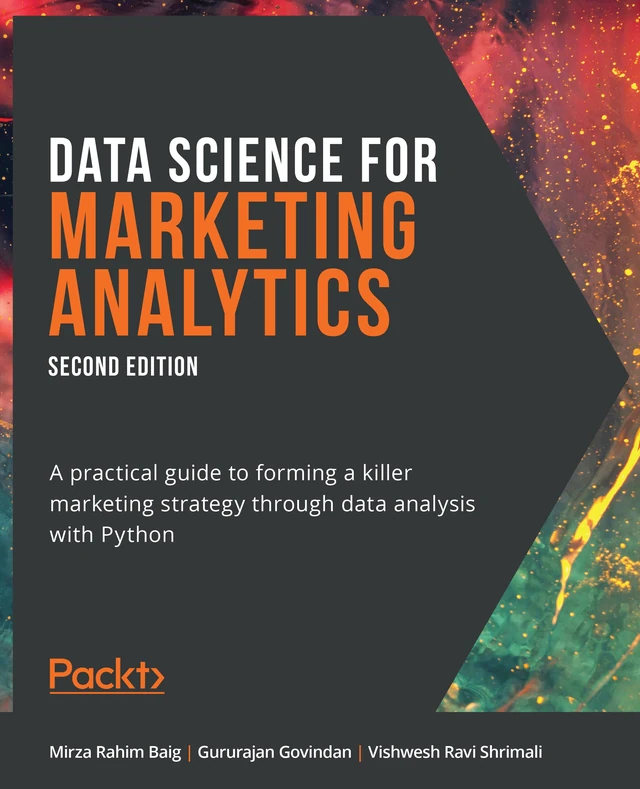
Data Science for Marketing Analytics
A practical guide to forming a killer marketing strategy through data analysis with Python
Packt · Second edition · 2021 · EnglishISBN 9781800560475Original book cover; the language and edition are identified alongside it.
Start with data rather than a fashionable algorithm
Early chapters address pandas, importing and combining data, missing values and visualization. Later work includes customer segmentation, regression, churn prediction and classification. These are distinct tasks: describing segments differs from predicting departure, and predictive usefulness does not establish a causal mechanism.
Reproduce a small exercise before importing your own large dataset. Record what each transformation changes and why. Read the completed notebook as a workflow another person must understand, rather than a private history of experiments.
Turn prediction into a decision
Illustration created by Lê Minh: a service wants to identify customers at risk of leaving. Specify when prediction is needed, which information exists then and what action would follow. Information available only after departure cannot support the earlier decision.
After the modeling chapters, describe evaluation on data not used for learning and the costs of different errors. This is an application framework, not a business result reported in the book. It connects statistical performance with intended use.
Keep the evaluation period separate from model development and explain why it resembles the intended use. A score becomes more informative when readers know which future decision, population and time window it is meant to support.
Practice with the right expectations
Packt’s official code repository supports comparison with exercises, but Python packages have changed since 2021. Use a separate environment and preserve versions rather than assuming all code remains unchanged. The book suits readers with basic Python and an interest in marketing analytics. It does not replace research-design or causal-inference texts. Its practical appeal is completing an inspectable path from raw data to a model supporting a clearly stated decision.
Choose a companion reading
Continue with: Marketing Insights from A to Z (First edition · 2003 · English).
Source and edition
Baig, M. R., Govindan, G., & Shrimali, V. R. (2021). Data science for marketing analytics (2nd ed.). Packt.