
A book on corporate social responsibility law in Vietnam
Corporate philanthropy does not answer every question about corporate responsibility. Laws on Corporate Social Responsibility and the Developmental Trend in Vietnam (2023) offers a route toward more specific questions: what creates an obligation, who can demand its fulfillment and how workers are protected.
Start reading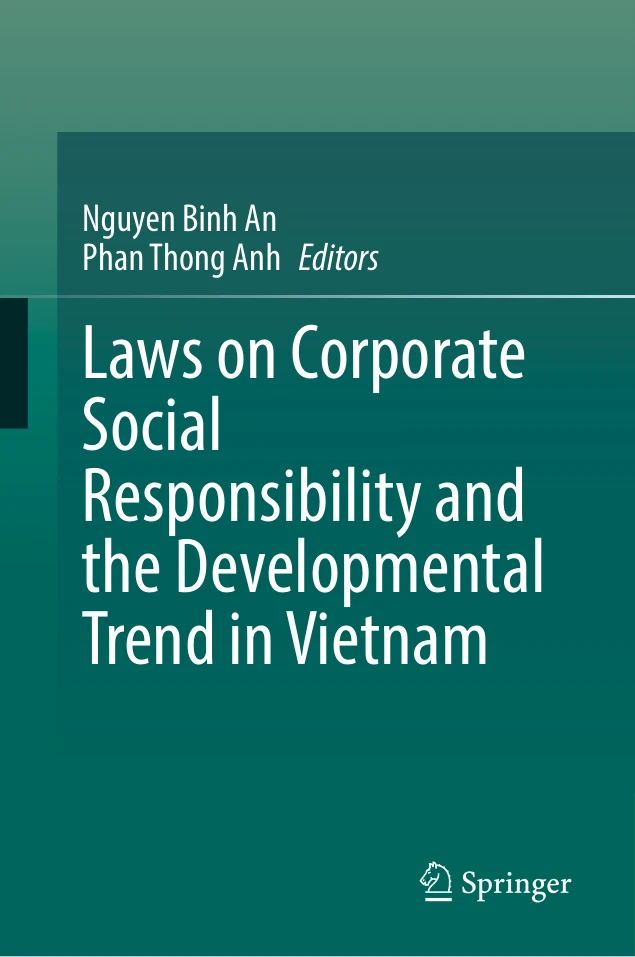
Laws on Corporate Social Responsibility
and the Developmental Trend in Vietnam
Springer · 2023 · EnglishISBN 9789811992551Original book cover; the language and edition are identified alongside it.
A collection of perspectives
Edited by Nguyen Binh An and Phan Thong Anh, the volume includes contributions on hard and soft law, business and human rights, labor rights, child labor and COVID-19. It is a research collection with individual chapter authors, rather than a consolidated legal instrument.
The hard-law/soft-law distinction provides a useful reading anchor. A legal duty, voluntary commitment and stakeholder expectation can have different standing even when all are discussed under CSR. Keeping those layers separate improves conceptual precision.
A useful challenge for survey research
An employee-perception scale cannot establish legal compliance. A written duty cannot establish what employees actually experience. Before specifying a CSR variable, decide which of these levels your question concerns.
Learning exercise created by Lê Minh: for a CSR–employee-engagement project, separate labor obligations, publicly described corporate activities and employee perceptions. Identify suitable evidence for each before drafting the questionnaire. This is a preparation framework, not a validated scale taken from the book.
Read and verify selectively
Start with hard and soft law, then select the rights or employment context relevant to your project. Record each chapter’s argument, legal basis and date separately. Cite the chapter author when using a particular contribution.
For current applications, check authoritative legal texts and their effective dates. A 2023 publication is not automatically current legal guidance. The book’s role is to sharpen the conceptual and contextual questions that subsequent verification must address.
Who should consider it
Business, human-resource and socio-legal researchers may benefit from the Vietnam-specific context. Readers seeking a ready-to-administer CSR questionnaire will need additional measurement literature. The productive takeaway is a more precise account of responsibility, accountable actors and evidence of implementation, rather than a simple label that a company either “has CSR” or does not.
Choose a companion reading
Continue with: Encyclopedia of Sustainability in Higher Education (2019 · English).
Source and edition
Nguyen, B. A., & Phan, T. A. (Eds.). (2023). Laws on corporate social responsibility and the developmental trend in Vietnam. Springer. https://doi.org/10.1007/978-981-19-9255-1