
Introducing Handbook of Structural Equation Modeling
Some questions cannot be settled by revisiting a worked example: how missing data affect choices, what ordinal indicators require, or whether factor scores can be carried into another analysis. The second edition of the Handbook of Structural Equation Modeling, edited by Rick H. Hoyle (2023), offers routes into those deeper discussions.
Start reading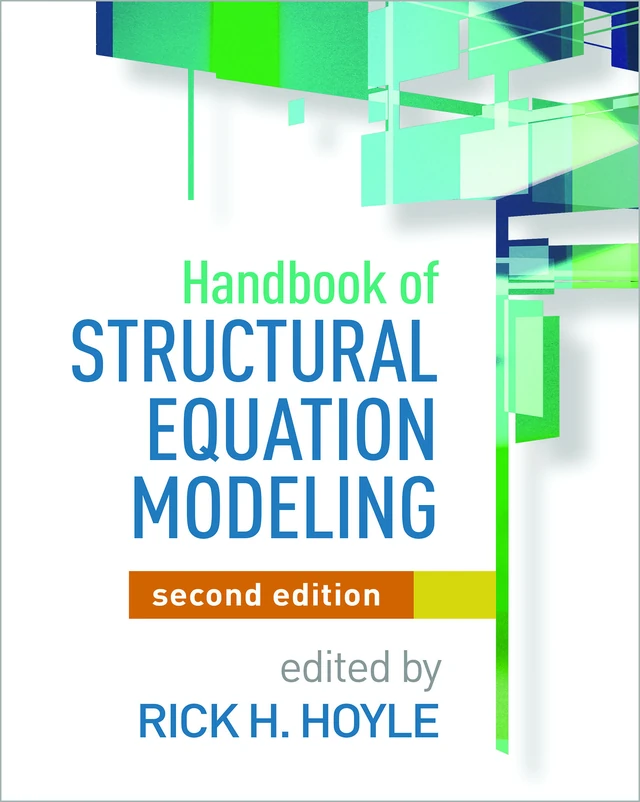
Handbook of Structural Equation Modeling
The Guilford Press · Second edition · EnglishISBN 9781462544646Original book cover; the language and edition are identified alongside it.
Breadth with identifiable authors
Foundation chapters address causal reasoning, visualization, latent variables, simulation, assumptions, estimation, power, fit, model selection and missing data. Application coverage includes CFA, binary and ordered indicators, parceling, factor scores, bifactor models and invariance.
This breadth makes the handbook a reference rather than a beginner’s linear course. Hoyle is the editor; individual chapters have their own authors and emphases. Cite the contribution actually supporting an argument.
Open it when a decision needs depth
Read the parceling discussion before treating parcels as a shortcut to a simpler model. Read about factor scores before using them as ordinary observed variables. When addressing a reviewer, investigate alternatives and conditions rather than searching only for a sentence endorsing what you already did.
Suggested exercise created by Lê Minh: select one problem, describe your data on half a page, then compare relevant options, assumptions and limits after reading its chapter. Keep unmet conditions explicit. Follow key references back to original methodological work.
This turns the handbook into a starting point for analysis rather than another prestigious citation in a bibliography.
Who should use it
Beginners may prefer Kline for an initial sequence, using the handbook selectively afterward. Doctoral readers, instructors and reviewers can benefit from its specialist range. This article introduces the 2023 second edition, ISBN 9781462544646. Reading one relevant chapter deeply can be more valuable than attempting the entire volume without a question to guide you.
Choose a companion reading
Continue with: Principles and Practice of Structural Equation Modeling (Fifth edition · 2023 · English).
Source and edition
Hoyle, R. H. (Ed.). (2023). Handbook of structural equation modeling (2nd ed.). Guilford Press.