
Scale Translation and Adaptation: From Conceptual Equivalence to Between-Group Testing
Accurate wording does not ensure that two versions measure the same construct. A sound adaptation must preserve meaning, suit its context and produce psychometric evidence.
This guide covers permission, conceptual equivalence, forward translation, reconciliation, back translation, expert review, cognitive interviews, piloting, CFA, invariance and APA 7 reporting.
1. Objectives and prerequisites
Scale adaptation is a measurement project, not an isolated translation task. It aims to suit a language, culture and population while retaining the original construct. International Test Commission guidance requires adaptation when moving instruments across cultural contexts, even when groups share a language (International Test Commission, 2017).
Obtain the correct original version, construct and dimension definitions, scoring instructions, development evidence, copyright information and a description of the new population. Pause before translation if ownership or the authoritative version cannot be established.
- Obtain written permission to use, translate or adapt copyrighted instruments where required.
- Identify the original version, item count, response scale and scoring rules.
- Describe country, language, dialect, age group and use context.
- Operationally define constructs and dimensions.
- Include content, measurement and language expertise and target-population representatives.
2. Translation versus cultural adaptation
Semantic equivalence concerns lexical meaning. Idiomatic equivalence addresses expressions that cannot be translated literally. Experiential equivalence asks whether situations are familiar to respondents. Conceptual equivalence asks whether adapted content still represents the same construct (Beaton et al., 2000).
A close translation can fail because examples, recall periods, social roles or forms of address are inappropriate. Adapting an example may preserve the original concept better than literal translation.
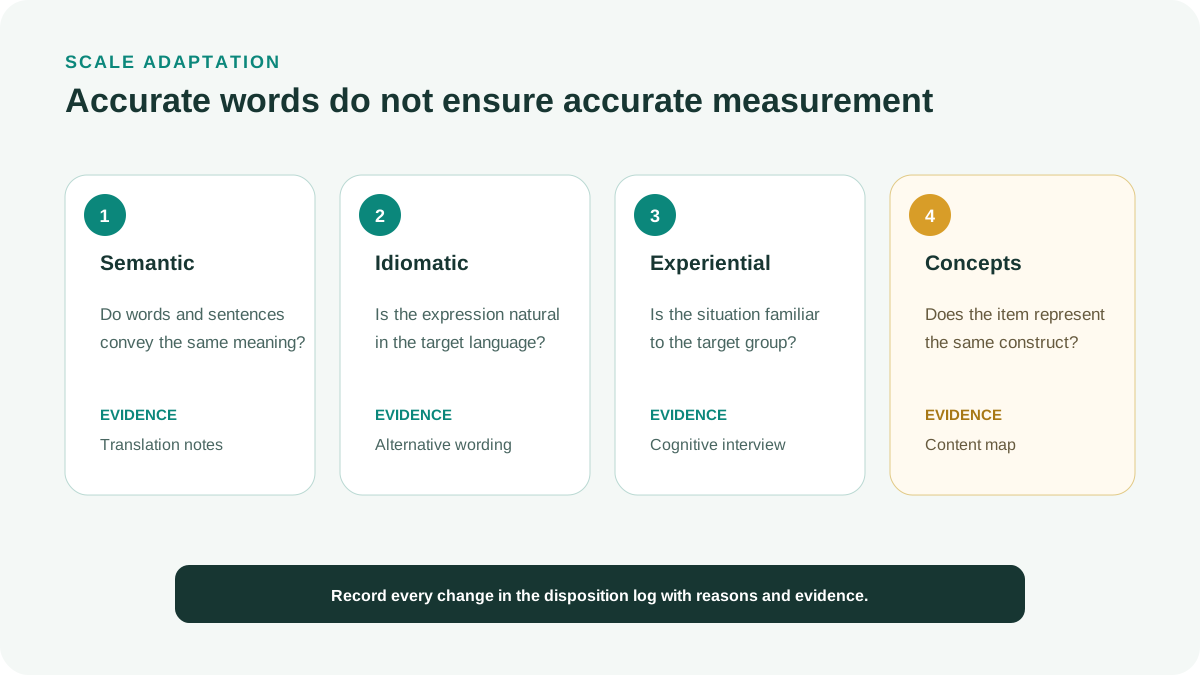
| Equivalence type | Assessment question | Evidence to retain |
|---|---|---|
| Semantic | Do words and sentences communicate the same meaning? | Translation notes and word-choice reasons |
| Idiomatic | Is the expression natural in the target language? | Alternatives discussed |
| Experiential | Has the target population encountered the situation? | Cognitive-interview feedback |
| Conceptual | Does the item still represent the same construct? | Content map and expert assessment |
3. Target-population use or comparison across languages?
Decide this before planning validation. Using a Vietnamese version within its intended population requires evidence about content, interpretation, structure, reliability and relationships with other variables in that population. Without source-language data, cross-version equivalence remains untested. That does not mean every within-population application must stop (International Test Commission, 2017, C-2).
Comparing relationships or means, or using scores interchangeably across versions, requires an additional comparative design. Evaluate administration methods, equivalence and the specific type of score being compared. Separate well-fitting CFAs do not replace a joint invariance analysis. Conditions for latent-mean comparisons do not themselves establish a conversion table for observed scores or transfer diagnostic cutoffs from the source version (International Test Commission, 2017, C-4 and SSI-2).
| Purpose | Priority evidence | Unsupported conclusion |
|---|---|---|
| Use within the target population | Measurement quality and interpretation in that population | The language versions are interchangeable |
| Compare group relationships | Invariance relevant to the compared parameters and a direct difference test | Significant in one group and nonsignificant in the other proves a difference |
| Compare latent means | Loading, intercept or threshold conditions under the chosen model | All raw scores or cutoffs are equivalent |
| Convert or interchange scores | A suitable linking/equating design with its own evidence | Similar alpha or a close back translation is sufficient |
4. permissions, source version and change plan
Publication of a scale does not automatically permit modifying or releasing translations. Requests to authors or owners should describe objectives, population, language, scope, planned publication and attribution. Preserve permission correspondence.
Start a disposition log containing item ID, original text, translations, identified problem, final decision, decision-maker and evidence. It documents changes and prevents accidental use of intermediate versions.
Removing items, changing categories or recall periods can change scores and validity evidence. Treat necessary changes as measurement decisions requiring reassessment.
5. conceptual and content equivalence
Before translating, map constructs, dimensions, definitions, content coverage and item roles. Experts should assess relevance to the population and identify absent, sensitive or differently expressed concepts.
Assess relevance, comprehensiveness and comprehensibility, the three COSMIN content-validity pillars (Mokkink et al., 2018). I-CVI and S-CVI can summarize expert ratings, but cannot replace qualitative comments or domain decisions (DeVellis & Thorpe, 2022).
- Link every item to a content-map aspect.
- Experts assess relevance, comprehensiveness and comprehensibility.
- Identify nonequivalent concepts before translating.
- Do not use CVI as the sole adaptation-quality evidence.
6. Choose a translation design and record independent roles
This guide proposes two independent forward translations followed by reconciliation as one practical design. Beaton et al. (2000) describe a multiple-translator procedure, while ITC emphasizes a suitable design and combined language, cultural, content and measurement expertise (International Test Commission, 2017, TD-1 and TD-2). A fixed translator count is not a sufficient condition for every adaptation.
Record who produced each version, relevant expertise, materials seen and when access to other versions began. Independence must occur while alternatives are being generated: two A/B fields completed by one person do not establish independent translations. Content expertise helps preserve technical meaning; knowledge of current language in the target population helps identify awkward or unfamiliar phrasing.
If AI suggests wording, record the tool, date, task and human revisions. Two generated outputs are not two independent expert judgments. Qualified people must review the content and test it with intended respondents. This is a practical documentation recommendation of this guide, not a claim that the 2017 ITC document prescribed an AI workflow.
- Assign translation, reconciliation, measurement-review and respondent-interview roles.
- Retain each pre-reconciliation version rather than overwriting it.
- Provide the construct definition, score purpose and target-population description.
- Document machine assistance, if any; identify the person responsible for final decisions.
7. Reconcile meaning, wording and scoring rules together
Explain why a proposed translation better preserves the construct and suits intended respondents. Fluency alone is not the decision rule. Use definitions, experience-based examples and pretest feedback to distinguish meaning changes from stylistic differences, and retain unresolved disagreements (International Test Commission, 2017, TD-2 and Doc-1).
Connect every revision to an item version and codebook. Rewriting a negative statement positively does not permit retaining its old R flag or reverse-scoring formula without review. Recheck meaning, score direction and permission, then retest with respondents. Changing recall periods, examples or response categories can also change the measurement task and requires an explicit decision.
| Hypothetical item/version | Problem | Decision | Evidence and scoring |
|---|---|---|---|
| Q04 v1 → v2 | Unfamiliar terminology | Propose accessible wording | Probe interpretation; confirm score direction |
| Q09 v1 → v2 | Unfamiliar situation | Propose a functionally equivalent description | Check content, permission and target-group experience |
| Q12R v1 → v2 | Double negation | Rewrite for testing, not final approval | Review reversal flag and formula; do not automatically reuse the old codebook |
8. Back translation is one check with specific limits
When the chosen design includes back translation, use qualified translators and appropriate separation from the source version so discrepancies can emerge. Look for lost or added meaning, altered intensity and a changed target of judgment. Beaton et al. (2000) and Sousa and Rojjanasrirat (2011) place this check within a wider process, rather than treating it as a quality certificate.
ITC warns that making a target-language item easy to back translate can leave it awkward for respondents. Forward and backward designs have limitations; explain the choice and how the target-language version itself was examined (International Test Commission, 2017, TD-2). A close back translation cannot show that respondents understand the intended time frame, referent and response categories.
Expert review, respondent feedback, operational testing and quantitative evidence address different questions. No single step replaces them all.
9. expert synthesis
Include content, method and language specialists and population representatives. Review originals, translations, back translations, decisions and early feedback. Distinguish meaning, style and measurement decisions so discussion does not reduce to attractive phrasing.
Produce a prefinal version with administration, response and scoring instructions. If equivalence is impossible, seek permission to revise, test the item as new or exclude it from cross-group comparison.
10. cognitive interviews with target respondents
Investigate comprehension, retrieval, judgment and response mapping. Use think-aloud or probes asking what a question means, which period respondents considered, why they selected a category, and which words are difficult or unnatural.
Purposively include variation in age, education, region and experience. Use small iterative rounds, revise and retest. The aim is identifying and explaining response problems, not statistical inference (Willis, 2005).
- Use a consistent probing guide with room for follow-up.
- Record problems by item and cognitive stage.
- Include groups at risk of different interpretations.
- Retest every revision in a later round.
- Stop when no new serious problems emerge, not at an arbitrary participant count.
11. Turn respondent feedback into traceable revision decisions
DeVellis and Thorpe (2022) recommend investigating interpretation and response formation. Each participant may probe only a subset of items or questions to reduce burden, provided the interviews collectively cover the required content. The aim is not to eliminate every critical comment: developers must balance natural language with construct integrity.
The following is a constructed example for the candidate statement “I can easily reach academic support when needed.” No fixed interview count guarantees completion. Cover circumstances likely to produce different interpretations, record unresolved problems and retest important revisions. This provides response-process evidence, not a test of factor loadings or statistical equivalence.
| Process | Nonleading probe | Hypothetical problem | Action to retest |
|---|---|---|---|
| Comprehension | What does reach mean to you? | Only in-person visits are considered | Clarify channels according to the construct definition |
| Retrieval | Which occasions did you think about? | A whole course versus the previous week | Specify a suitable recall period |
| Judgment | What did you consider when choosing this answer? | Access is mixed with professional competence | Separate content if the item asks two questions |
| Response mapping | What would you choose if you never needed help? | Neutral is used to mean no experience | Test instructions, applicability and missing-response rules |
12. Operational pilots and preliminary measurement studies have different aims
An operational tryout examines timing, routing, devices, instructions, inapplicable items and data errors. A quantitative pilot can also examine preliminary item performance and reliability when its sample and design support that purpose. ITC distinguishes developmental tryouts from full-scale confirmation; it does not prohibit statistical analyses in every pilot (International Test Commission, 2017, TD-5 and C-1).
Before each round, record its question, participants, version, evidence and progression criteria. Retest revisions to meaning, response options or applicability. Complete responses do not establish correct understanding, particularly in a compulsory-response form. A familiar pilot sample size is not a guarantee of adequate EFA, CFA or DIF estimation.
13. psychometric assessment
The adaptation needs structural, reliability and external-relationship evidence in the target population. Substantial changes or uncertain structure may require EFA followed by independent CFA. With clear original structure and limited adaptation, CFA can be primary. Diagnose failure rather than mechanically modifying fit indices.
For few-category, skewed or sparse Likert items, consider polychoric correlations and ordinal estimators such as WLSMV (Flora & Curran, 2004). ML or MLR may suit approximately continuous, reasonably distributed data. Report the correlation matrix and estimator, not software alone.
| Question | Suitable analysis | Supported conclusion |
|---|---|---|
| Do items show the intended structure? | EFA or CFA | Structural evidence in the target sample |
| Are scores internally consistent? | Omega or model-appropriate reliability | Score precision |
| Do scores relate to other variables as theorized? | Convergent, discriminant and criterion evidence | Evidence from relationships with other variables |
| Are language versions comparable? | Measurement invariance or DIF | Supported parameter-comparison level |
14. Invariance must match the model, score and intended comparison
For multigroup CFA treating items as continuous, configural invariance addresses a common measurement configuration, metric invariance constrains loadings, and scalar invariance adds intercept constraints. These support different comparisons. Partial invariance requires identifying released parameters, the rationale and the comparisons still supported (Putnick & Bornstein, 2016). A model-wide label should not conceal a factor lacking the relevant comparability conditions.
Ordered items also involve thresholds and identification conditions that depend on estimator, response categories and parameterization. Do not transplant a continuous-item intercept sequence and call it scalar invariance for every Likert model. This article does not prescribe one universal ordinal constraint sequence. State the item type and procedure actually used, inspect parameter estimates as well as fit, and limit comparisons accordingly (International Test Commission, 2017, C-2 and SSI-2).
For PLS-SEM composites, consult MICOM rather than relabeling configural/metric/scalar tests as MICOM steps; the frameworks address different parameters. In either setting, a group difference in average item responses does not itself establish DIF. DIF asks whether equally positioned respondents on the measured attribute have different item response probabilities across groups. A flag requires substantive and methodological review, not an automatic verdict that translation is wrong (International Test Commission, 2017, C-2).
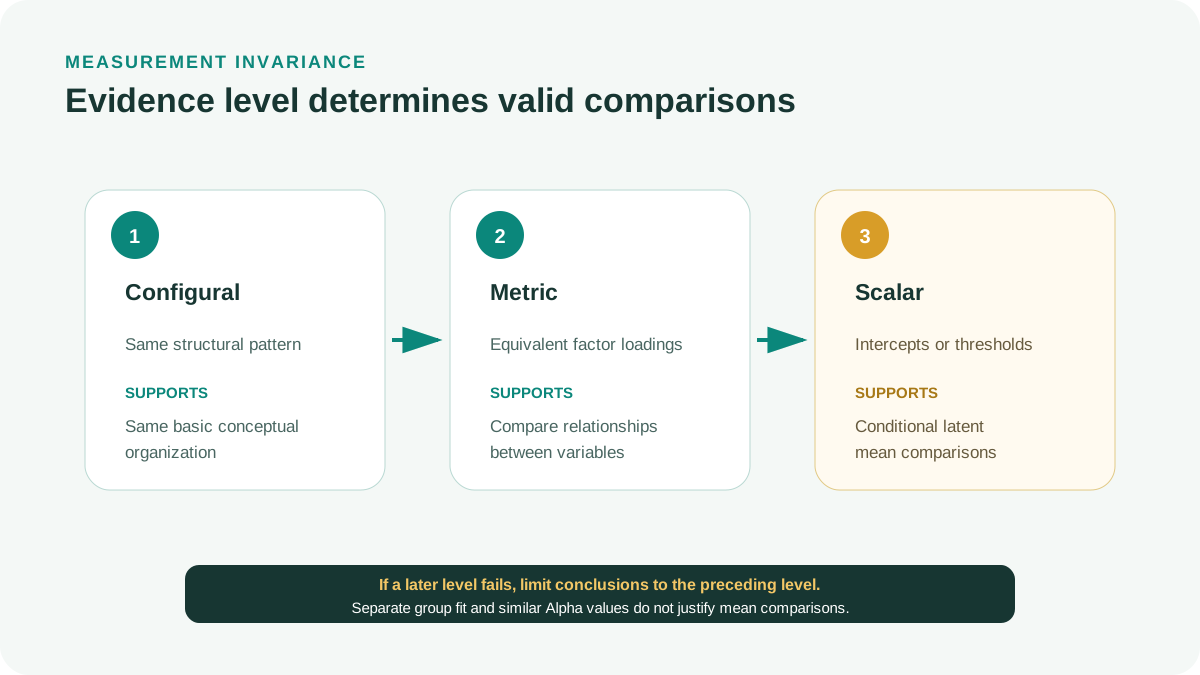
A CFA in the target population can support its within-group structure. It does not test cross-language invariance or establish equivalence between the versions.
15. Hypothetical adaptation of academic-support measures
This scenario and its numbers are illustrative, not empirical. A 12-item scale is translated into Vietnamese for doctoral researchers. Two independent translations, reconciliation and back translation identify three intensity changes. Two cognitive-interview rounds of eight participants each reveal that “office hours” means administrative hours to respondents; it is replaced with access to instructors outside class.
A 62-person pilot finds 18% missingness in one item inapplicable to distance learners. The team adds a not-applicable option and revises instructions. The main study uses ordinal CFA. Three-factor fit is acceptable; metric but not scalar invariance holds for two items. The team compares structural relationships without claiming latent mean differences.
| Finding | Decision | Reason |
|---|---|---|
| Term lacks an equivalent experience | Use a functional description | Preserve access-to-support meaning |
| Item inapplicable to distance learners | Revise instructions and options | Reduce design-induced missingness |
| Metric holds, scalar does not | Compare relationships, not yet means | Match conclusions to invariance evidence |
16. Keep an evidence package across all six ITC categories
ITC (2017) contains 18 guidelines in six categories, not a fixed nine-step translation checklist. This table is an author-created output map connecting the practical workflow to that scope. It does not reproduce the guidelines or replace reading them.
Version the final items, instructions, response options, codebook, missing-response rules, change history, evidence and approval together. Keep personal and access-restricted material in an appropriate private record; publish only permitted content. Completing fields in the website’s scale workspace records work but does not certify the scale’s quality.
| Guideline category | Record to examine | Question before freezing the version |
|---|---|---|
| Preconditions (PC) | Permission scope, construct and target population | Is there sufficient conceptual and permission basis to proceed? |
| Development (TD) | Translations, reconciliation, respondent feedback and pilots | Do respondents perform the intended response task? |
| Confirmation (C) | Sampling design, structure, reliability and equivalence | Does the evidence match the intended use? |
| Administration (A) | Instructions, device, timing and accommodations | Could differing conditions affect interpretation? |
| Scoring and interpretation (SSI) | Score rules and comparison or linking scope | Does the conclusion exceed the scores examined? |
| Documentation (Doc) | Change history and limits of use | Can another researcher trace the decisions? |
17. Nine-step practical workflow
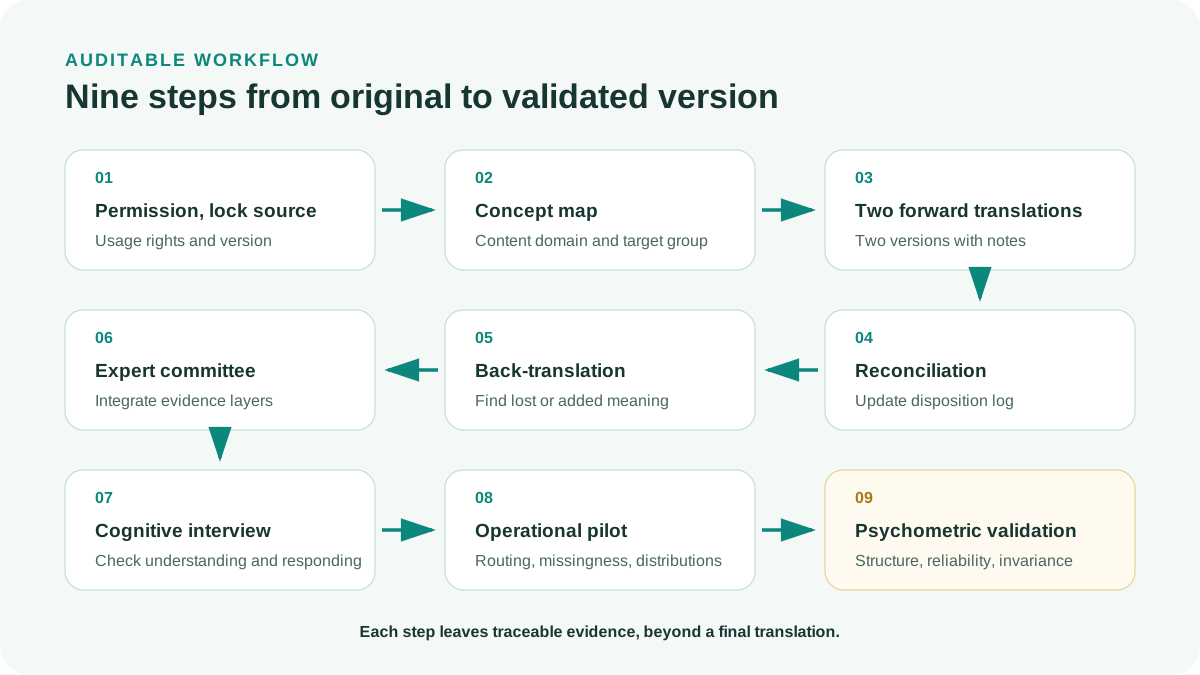
Obtain permission and fix the source version
Confirm adaptation rights, response scale, scoring and original materials.
Map concepts
Describe dimensions, domain, population and equivalence risks.
Translate forward independently
Produce at least two versions with wording notes.
Reconcile
Agree a version and update the disposition log.
Translate back
Find omissions, additions and intensity changes.
Expert panel
Integrate semantic, cultural, content and measurement evidence.
Cognitive interviews
Investigate understanding and responding over repeated rounds.
Operational pilot
Check flow, time, missingness, distributions and stopping criteria.
Psychometric confirmation
Assess structure, reliability, validity and invariance appropriate to objectives.
18. APA 7 reporting template and publication checklist
Reporting example in English
The instrument [name, source version, citation] was adapted for [population, setting and intended use]. Permission for use and modification was documented through [ ]. The translation design comprised [procedures actually completed], with [roles, expertise and independence arrangements]. [Number] cognitive-interview rounds with [participant characteristics] led to [revisions and retest evidence]. A pilot [purpose, N] examined [ ]. The main study N = [ ] used [item type, matrix, estimator, EFA/CFA], providing [evidence and limits]. Where group comparison was intended, [design] supported [comparison scope] but did not support [ ]. Changes were retained in a disposition log. Report the translation design actually used [ ], independent roles [ ] and machine assistance [if any]; do not report procedures that were not performed. Item/codebook version [ ] fixes score direction, missing-response rules and applicability. The intended use is [within-population use/group comparison/score linking]; conclusions are limited to [score type and evidence scope].
- State permissions and the source version.
- Describe translators, experts and pretest participants.
- Report translation, reconciliation, back-translation and cognitive-interview rounds.
- Give important changes and reasons.
- Separate operational piloting from psychometric assessment.
- State correlation matrix, estimator and software.
- Report competing models or model-selection reasons.
- Use reliability appropriate to the score structure.
- Report invariance levels before group comparisons.
- Do not call translation-only evidence a validated translation.
- List each reference and DOI only once per entry.
- Preserve the final instrument, instructions and disposition log.
Conclusion
A linguistically accurate translation may measure incorrectly. A trustworthy process connects permission, conceptual equivalence, controlled translation, target-respondent evidence and psychometric confirmation.
Match conclusions to evidence. Compare relationships or means across language versions only with appropriate invariance support.
References
- Beaton, D. E., Bombardier, C., Guillemin, F., & Ferraz, M. B. (2000). Guidelines for the process of cross-cultural adaptation of self-report measures. Spine, 25(24), 3186-3191. https://doi.org/10.1097/00007632-200012150-00014
- DeVellis, R. F., & Thorpe, C. T. (2022). Scale development: Theory and applications (5th ed.). SAGE. https://us.sagepub.com/en-us/nam/scale-development/book269114
- Flora, D. B., & Curran, P. J. (2004). An empirical evaluation of alternative methods of estimation for confirmatory factor analysis with ordinal data. Psychological Methods, 9(4), 466-491. https://doi.org/10.1037/1082-989X.9.4.466
- International Test Commission. (2017). The ITC guidelines for translating and adapting tests (2nd ed.). https://www.intestcom.org/files/guideline_test_adaptation_2ed.pdf
- Mokkink, L. B., Prinsen, C. A. C., Patrick, D. L., Alonso, J., Bouter, L. M., de Vet, H. C. W., & Terwee, C. B. (2018). COSMIN methodology for systematic reviews of patient-reported outcome measures: User manual. https://www.cosmin.nl/wp-content/uploads/COSMIN-syst-review-for-PROMs-manual_version-1_feb-2018.pdf
- Putnick, D. L., & Bornstein, M. H. (2016). Measurement invariance conventions and reporting: The state of the art and future directions for psychological research. Developmental Review, 41, 71-90. https://doi.org/10.1016/j.dr.2016.06.004
- Sousa, V. D., & Rojjanasrirat, W. (2011). Translation, adaptation and validation of instruments or scales for use in cross-cultural health care research: A clear and user-friendly guideline. Journal of Evaluation in Clinical Practice, 17(2), 268-274. https://doi.org/10.1111/j.1365-2753.2010.01434.x
- Willis, G. B. (2005). Cognitive interviewing: A tool for improving questionnaire design. SAGE. https://us.sagepub.com/en-us/nam/cognitive-interviewing/book225856
Methodological note: Numerical milestones are meaningful only within the context, design and disciplinary standards. A checklist cannot replace professional judgment or instrument-owner requirements.