

CONFIRMATION QUADROUP ANALYSIS IN PLS SEM (CTA-PLS)
The purpose of CTA analysis (Confirmatory tetrad analyses) in PLS SEM is to determine whether the measurement model is formative or reflective. However, according to Hair and colleagues (2017), the conversion of measurement mode of latent variables (from effect form to cause form and vice versa) based only on CTA results will not be possible. meaningful unless the underlying theoretical or conceptual logic provides support for this change.
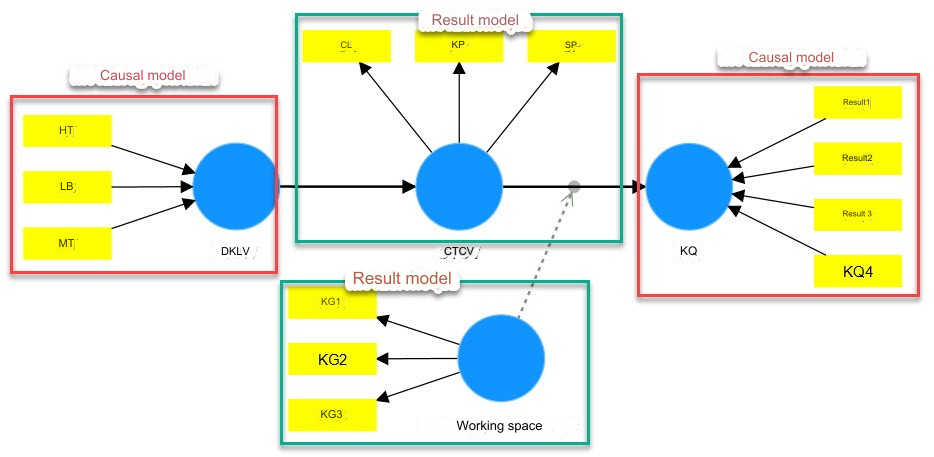
To help you easily visualize the two cause and effect models, we present some distinguishing features between these two types of models as follows (According to Jarvis et al. (2003) cited from Hair et al. (2017):
| STT | Causal model | Result model |
| 1 | The direction of causality is from the observed variables to the research variables. | The direction of causality is from the research variable to the observed variables. |
| 2 | Observed variables determine the characteristics of the research variables. | Observed variables are reflections (or manifestations) of research variables. |
| 3 | Changes in observed variables will cause changes in research variables. | Changes in observed variables will not cause changes in research variables. |
| 4 | Observed variables do not need to have similar content; Observed variables need not share a common theme. | Observed variables must have similar content; Observed variables should share a common theme. |
| 5 | Removing observed variables can change the conceptual domain of the research variable. | Removing the observed variable does not change the conceptual domain of the research variable. |
| 6 | Observers need not have the same impacts and consequences. | The observers must have the same impacts and consequences. |
When to run CTA-PLS analysis? when you have not determined the type of measurement model that is cause or effect (research model has not been determined).
As we have mentioned the original purpose of CTA, we will now show how to test CTA for a causal model (formative model). Before performing the testing steps, we have a few notes (necessary conditions for formative models) to run CTA, which is that each structural variable must be measured by at least 4 observed variables, and Maximum of 25 observed variables. In case you run the PLS SEM model and all constructs have 3 or less observed variables, you will not be able to run CTA or CTA will not give results for constructs with only 3 observations or less.
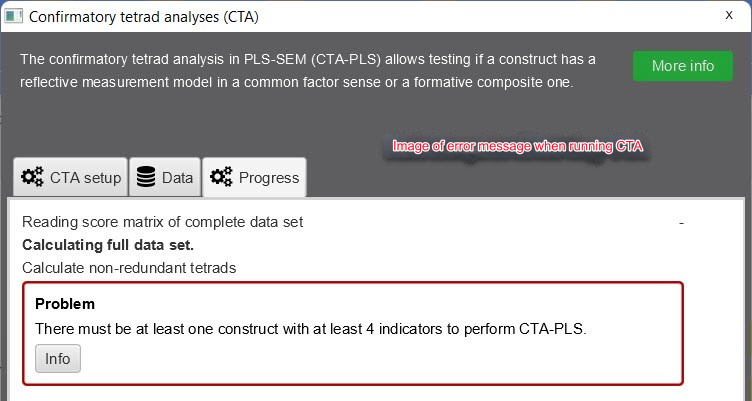
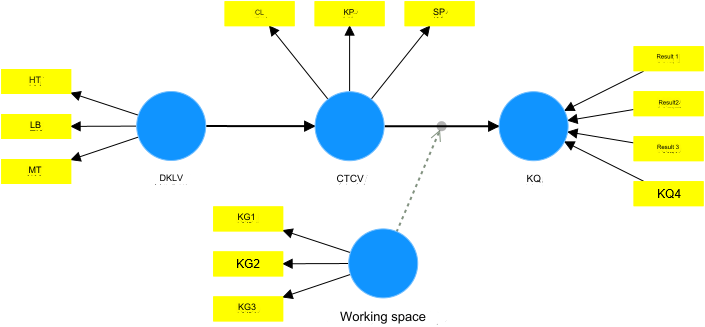
Now to guide you through CTA analysis, we will use the following illustration model:
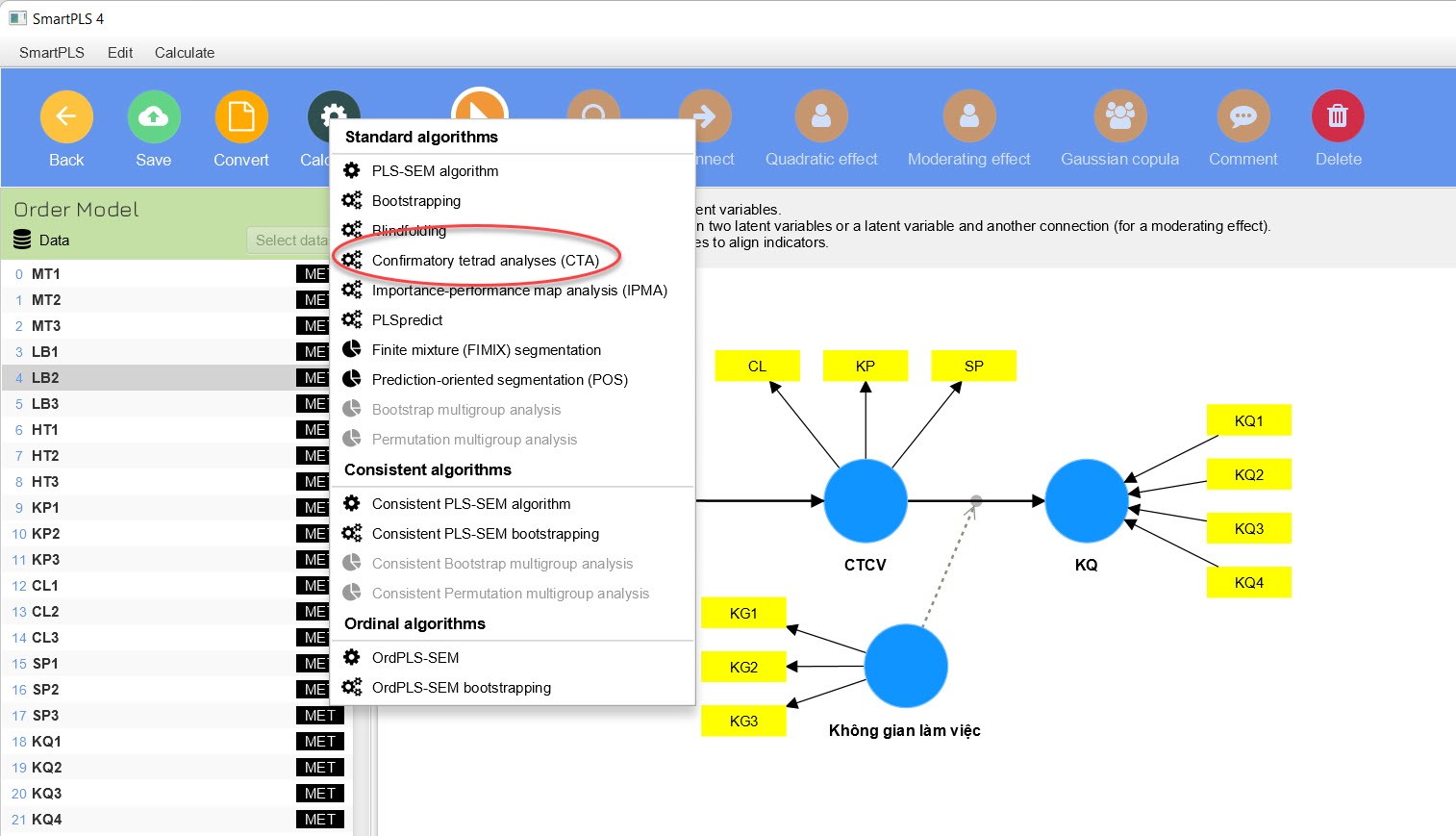
Step 1: Run CTA analysis from the SmartPLS screen
Step 2: Read the results from the Report of the SmartPLS program
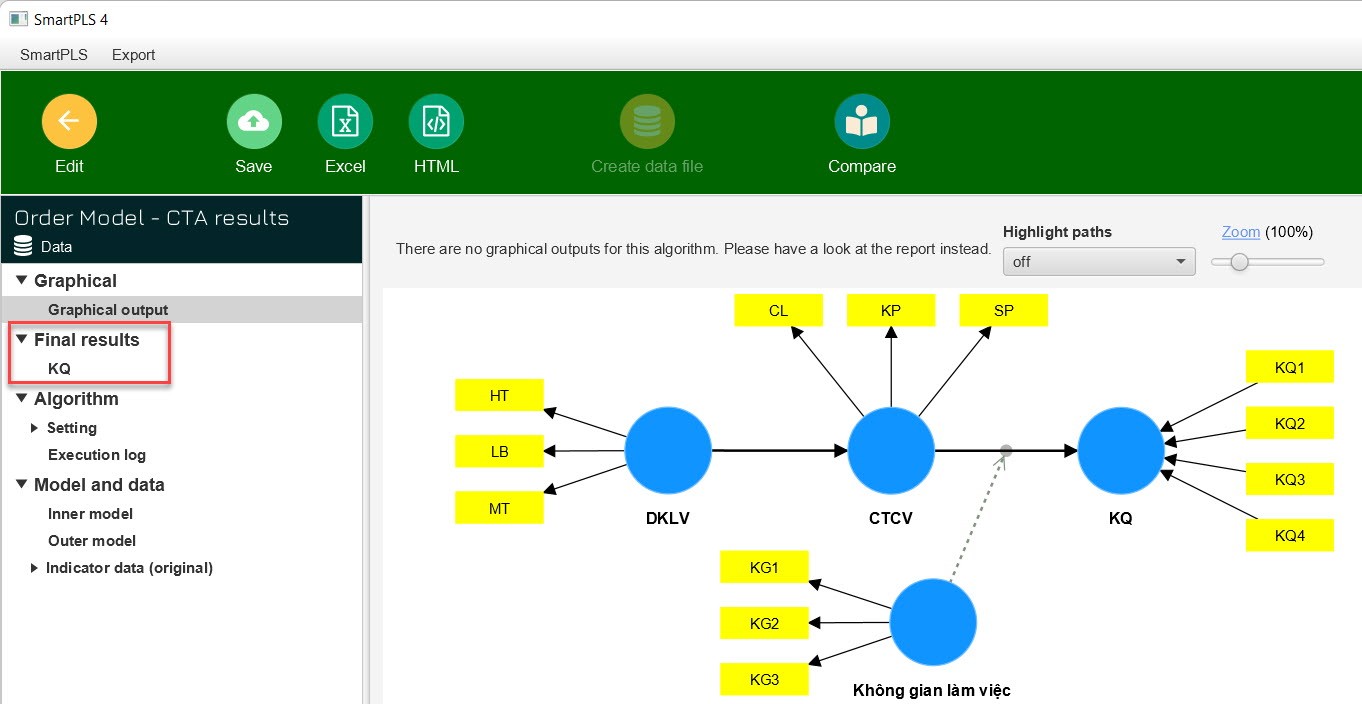
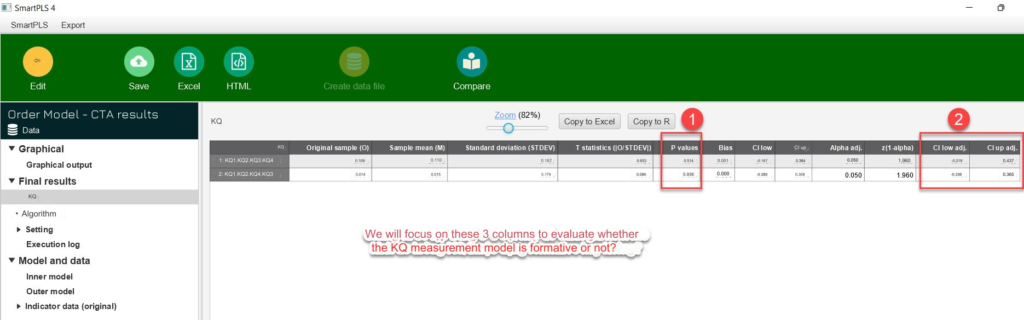
What are the criteria to conclude whether a measurement model is a formative model or not?
- If 80% of the CTA analysis combinations have a P-value greater than 5%, it can be concluded that it is a reflective construct, or a reflective model. If there are documents, leave 90% as Hair et al. (2017).
- If the confidence interval from low to high contains the value 0 (zero), it is concluded that it is a reflective structure, or the resulting model.
When analyzing CTA, we need to combine both of the above conditions to conclude whether a structure is formative or reflective. Of the two conditions above, condition number 1 is the first priority. Because there are many cases of overlapping conditions.
Specifically, in the case of illustrating the data here, we see that:
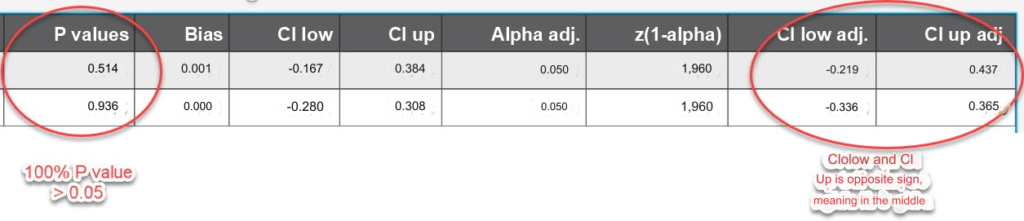
100% of the combinations have a p value greater than 5%, and the confidence interval from low to high passes through zero. So the KQ scale in this case cannot be formative, but must be reflective. Therefore, you need to adjust the model accordingly. The model after adjustment is as follows:
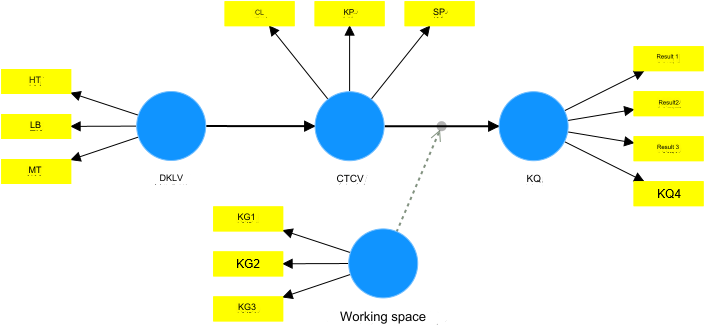
Note that CTA-PLS analysis results are just one means of providing us with an overview of the appropriate form of a measurement model (cause or effect). The main factor to decide the appropriate form of measurement model is still theoretical and research concepts.
Above is a model with only one construct measured by 4 observed variables, so the CTA result has only one construct (KQ). In case the model contains many constructs with more than 3 observed variables, analyzing the CTA will yield more construct results.
References:
Hair Jr, J. F., Sarstedt, M., Ringle, C. M., & Gudergan, S. P. (2017). Advanced issues in partial least squares structural equation modeling. saGe publications.
Jarvis, C. B., MacKenzie, S. B., & Podsakoff, P. M. (2003). A Critical Review of Construct Indicators and Measurement Model Misspecification in Marketing and Consumer Research. Journal of Consumer Research, 30(2), 199–218. https://doi.org/10.1086/376806